


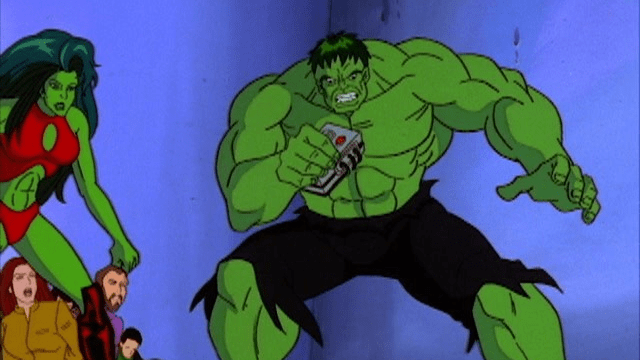

In this journey through the Marvel Animated Universe, I’ve tried — really tried — to find something redeemable in every installment. It hasn’t always been easy (Jubilee’s Fairytale Theatre, anyone?), but I’ve managed. And now we arrive at Fashion Warriors, an episode that’s technically a base-under-siege with action and tension. Whether that tension is dramatic or just the bones of the series creaking under its own weight is another matter entirely.
The Leader, once a brilliant gamma tactician, now sits in a control booth delaying a celebrity fashion show because he’s broke. Yes, broke. Gargoyle — once a fearsome villain with a tragic backstory — devolves into a drooling caricature the moment She-Hulk arrives, salivating over screens of scantily clad women and licking his lips at her threats. It’s not villainy. It’s vaudeville.
And the fashion show itself? Less girl power, more pseudo-sci-fi cosplay with zero personality. Betty Ross, once a respected gamma physicist, is dragged into the spectacle not to facilitate a cure for Bruce Banner, but to prompt a booty call! When Ogress walks the runway in a wedding gown, every character — hero and villain alike — calls her ugly. It’s mean-spirited, juvenile, and beneath the talents of John Semper, who once helmed Spider-Man: The Animated Series with nuance and flair.
Then there’s the martial arts heel strike. Yes, really. One of the women weaponises her stiletto. And just as the Hulk finally breaks loose — for a paltry thirty seconds — the Leader asks, “What else could possibly go wrong?” before answering himself: “I had to ask.”
By the time the episode ends, with the Leader muttering “How are we out of gas?”, it’s hard not to hear the writers speaking through him. The season’s running on fumes. And Fashion Warriors, for all its glitter and noise, is proof that when you strip away the gamma, the glamour isn’t enough.
She-Hulk receives an invitation to model at a high-profile fashion benefit in Miami. Bruce Banner tags along, reluctantly. What he doesn’t know: Betty Ross is also walking the runway.
The event glitters — until the Leader arrives. He’s brought the Gamma Warriors: Abomination, Gargoyle, and Ogress. Their plan is simple — take the celebrities hostage and demand a hundred million in ransom.
They strike fast. Hulk is caught off guard and knocked out with sleeping gas.
But the runway isn’t empty. She-Hulk, Betty, and the other models regroup. They fight back — not with brute force, but with sabotage, subterfuge, and style. One by one, they unravel the Leader’s plan.
Hulk wakes. He’s outmatched. The Gamma Warriors are too strong. But there’s a bomb ticking, and hostages to save. Hulk and She-Hulk let the Leader escape — his vessel, a flying submarine, vanishes into the sea.
It doesn’t get far.
The ship runs out of fuel and sinks. The Leader demands answers. Gargoyle shrugs: they’re broke. “I can’t buy fuel with my good looks alone!” Ogress smirks. “I could do that.”
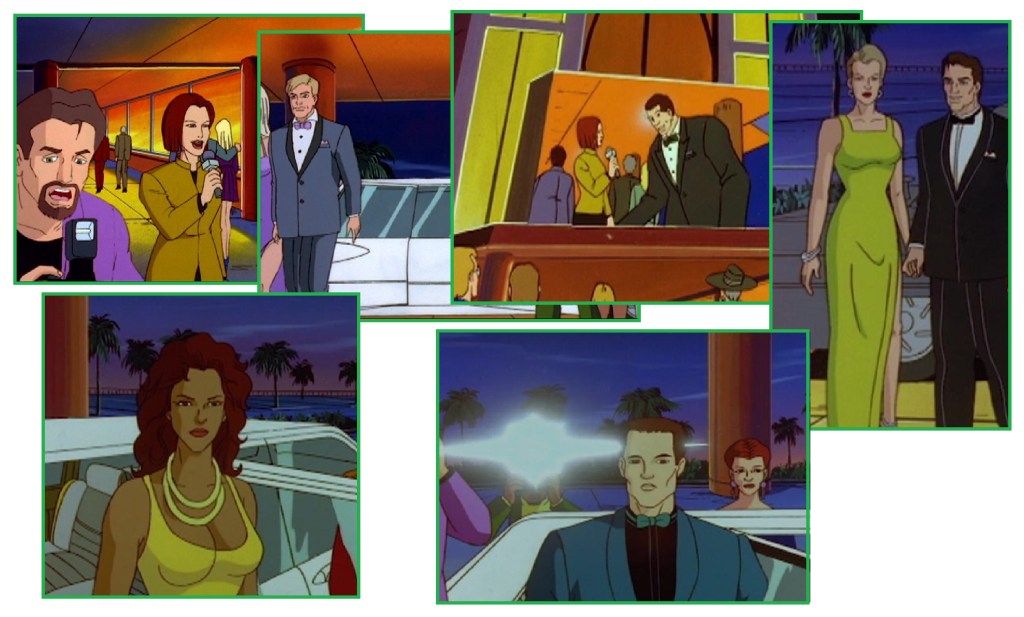
Several celebrities can be seen on the red carpet: voice actors Mark Hamill (Gargoyle), Matt Frewer (the Leader), Kathy Ireland (Ogress), Luke Perry (Rick) and Cree Summer (She-Hulk). Lou Ferrigno, the Hulk himself, even waves at the camera!
This is the final episode to feature the Leader, Gargoyle and the Gamma Warriors.
THE HEART OF THE HULK: BETTY ROSS
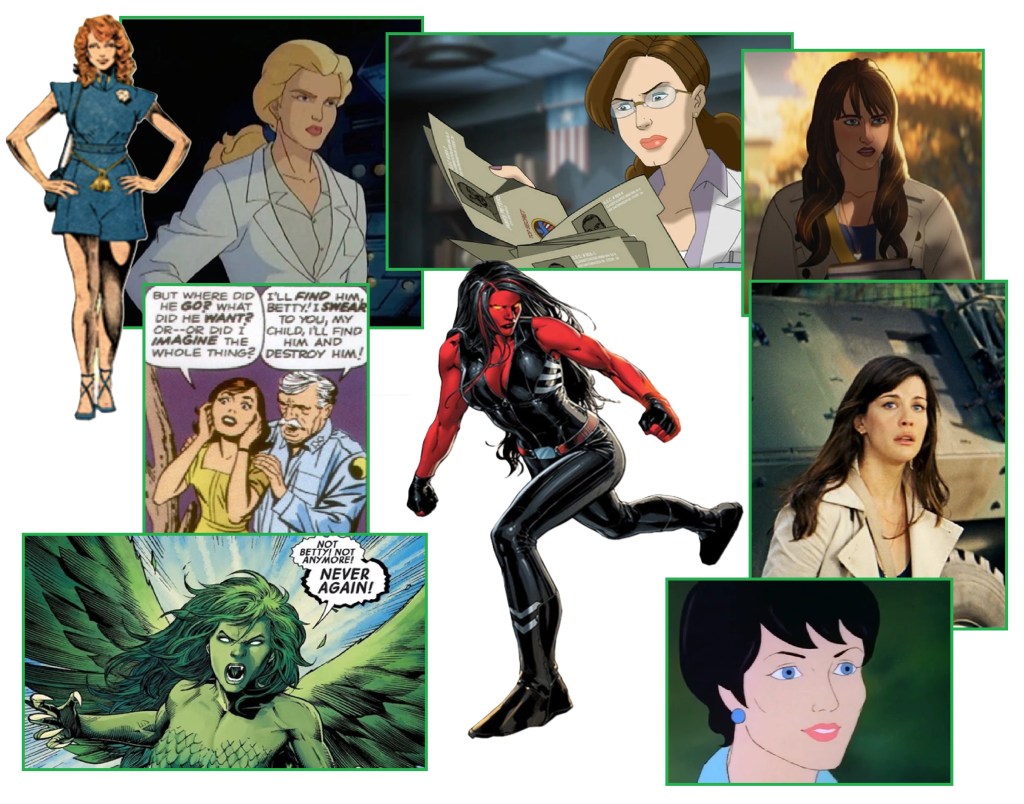
Betty Ross first appears in The Incredible Hulk #1, created by Stan Lee and Jack Kirby. From the beginning, she’s more than a love interest — she’s the emotional anchor in Bruce Banner’s chaotic world. Daughter of General Thaddeus “Thunderbolt” Ross, Betty is caught between loyalty to her father and her love for the man he’s sworn to destroy. Her journey is one of endurance, heartbreak, and transformation.
Betty’s relationship with Bruce is mythic in scale — a tragic romance haunted by gamma radiation and military obsession. She sees the man beneath the monster, even when the world refuses to. But her story isn’t static. Over time, Betty evolves. She becomes a scientist, a strategist, and eventually, something far more dangerous.
In Incredible Hulk (vol. 2) #168, Betty’s arc deepens as she begins to confront the cost of loving Bruce. But it’s in Hulk (vol. 2) #15 (September 2009) that she undergoes her most dramatic transformation — becoming the Red She-Hulk. No longer just a witness to gamma fallout, Betty becomes a force within it. Her Red She-Hulk persona is volatile, powerful, and morally complex — a mirror to Bruce’s own fractured identity.
In animation, Betty appears in the 1982 and 1996 Incredible Hulk series, often as Bruce’s emotional tether. The 1996 version gives her more agency, allowing her to challenge both her father and the systems that keep Bruce hunted. In live-action, she’s portrayed by Jennifer Connelly in Hulk (2003) and by Liv Tyler in The Incredible Hulk (2008), each version highlighting different facets — the scientist, the romantic, the rebel.
Betty Ross is not defined by who she loves — she’s defined by what she survives. She’s been manipulated, mutated, and mourned. But she endures. Whether human or Hulk, she remains the heart of Bruce’s story — and sometimes, the fury.
In a world of monsters, Betty Ross is proof that strength isn’t always loud. Sometimes, it’s the quiet refusal to give up.




 X-Cess Minutiae
Leave a comment