


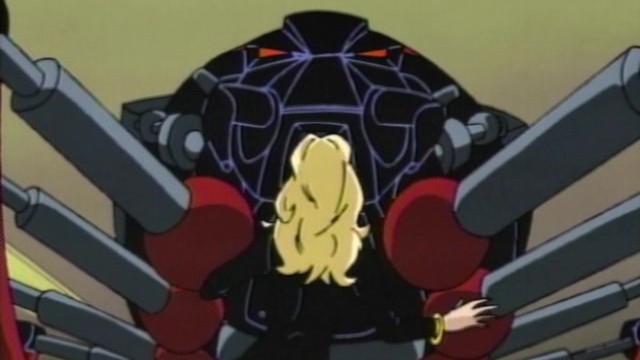

Second episode in, and the city’s already filling with faces. The Spider Slayer expands the ensemble with precision — not just more characters, but more emotional faultlines. Felicia Hardy enters as a Gwen Stacy echo: blonde, poised, and drawn to Spider-Man’s mystique rather than Peter’s awkward charm. Her presence reframes the romantic tension, setting the stage for Mary Jane’s eventual hurricane. Flash Thompson, meanwhile, is pure comic-book toxicity — mocking Peter for bringing Aunt May to the Hardy Foundation ball, then turning around to cosplay as his idol. He’s a fanboy with fists, and the irony lands hard.
The tone is layered — action, comedy, and character all in rhythm. Spidey’s quips hit their mark, whether he’s dodging drones or dancing around Felicia’s advances. Peter’s discomfort is palpable, especially when Felicia kisses him mid-ball, and Christopher Daniel Barnes threads it all together with a voice performance that never drops the emotional beat. He’s heroic, hesitant, and hilariously human — often in the same scene.
And then there’s the Kingpin. Already scheming, already lethal. Norman Osborn’s in his pocket, Spencer Smythe’s building weapons, and the Black Widow Spider Slayer is ready to strike. It’s only episode two, and the criminal underworld is already moving pieces across the board. The stakes are rising, the cast is converging, and Spider-Man’s world is getting bigger — and more dangerous — by the minute.
Spider-Man cuts through the skyline, mid-swing, when a swarm of surveillance drones descends. He dismantles them with precision, but the ambush is no accident. Behind the curtain: Spencer Smythe, his son Alistair, and Norman Osborn. Norman berates Spencer for the failure, but Spencer counters — this was a test. The real weapon is ready. He unveils the Black Widow: a new Spider Slayer, sleek, lethal, and waiting.
At the Daily Bugle, Felicia Hardy oversees preparations for the Hardy Foundation’s charity ball, flanked by J. Jonah Jameson. Peter Parker is assigned as photographer, caught between duty and discomfort. Across town, Oscorp finalises the Black Widow. Eddie Brock, circling like a vulture, prepares a broadcast to unmask Spider-Man once the Slayer delivers. Spencer confides in Alistair: he’s only working with Norman to build a hi-tech wheelchair for his paraplegic son. But the alliance is already fraying.
Norman meets with Kingpin. The order is clear — Spider-Man must be removed. Spencer and Alistair release spider-trackers to locate him. Meanwhile, at the ball, Felicia greets Flash Thompson and Harry Osborn, but her attention shifts when Peter arrives with Aunt May. Felicia pulls Peter into a dance, leaving Flash and Harry stewing. Outside, Flash dons a Spider-Man costume to spook Peter — just as the trackers lock onto him. Mistaking Flash for the real deal, Spencer deploys the Black Widow.
The Slayer crashes through the roof. Peter shields Aunt May, then vanishes into the chaos. Spider-Man engages the Black Widow, but the roof gives way. Flash, unconscious and still in costume, is captured. At Oscorp, Eddie begins his broadcast. Aunt May and Jameson watch in horror as “Spider-Man” is unmasked — but it’s Flash. The real Spider-Man interrupts, exposing the mistake. Armed men storm the lab. Eddie’s camera is destroyed. Peter races to save Flash.
Inside Oscorp, Spider-Man battles the guards. The Black Widow reactivates. Norman triggers a spider-tracker, but Peter disables it, sparking a fire. Norman, Alistair, and Eddie flee. Spencer stays behind, tethered to the machine. Spider-Man finds Flash and leaps onto the Slayer’s back. When the Widow recognises Flash, Peter jams web cartridges into its jets. The system clogs. The Slayer crashes into a vat of acid. Peter pulls Flash clear. Spencer is lost in the flames.
Back at the ruined ball, Jameson fires Eddie for humiliating the Bugle. Felicia, furious, severs ties with both Flash and Peter. Peter finds Aunt May. They leave together, quiet and shaken. At Oscorp, Kingpin approaches Alistair with a new offer: build more Slayers. Kill the Spider.
ROGUE’S GALLERY

SPENCER SMYTHE
He was a man of science, but not of restraint. Spencer Smythe didn’t build the Spider Slayer to protect the city — he built it to prove a point. That Spider-Man was a menace. That machines could do what men could not. His obsession was clinical, almost surgical, and yet it burned with the intensity of a personal grudge. When he debuted in The Amazing Spider-Man #25 (1965), it wasn’t as a villain in costume, but as something more insidious: a mind convinced it was right.
Smythe’s genius was undeniable. His Slayer was a marvel of robotics, able to track Spider-Man through his unique radiation signature, adapting to his movements with eerie precision. But it was never enough. Each defeat only deepened his resolve, pushing him further into isolation and bitterness. He became a fixture in Peter’s life — not through brute force, but through persistence. A man who couldn’t let go, who saw Spider-Man not as a hero, but as a flaw in the system he was trying to perfect.
In the animated canon, especially the 1994 series, Smythe’s legacy is felt more through his son, Alistair, but the foundation is his. Spencer was the architect. The origin point. The man who turned scientific inquiry into a vendetta. And when the machines failed, it wasn’t the tech that broke — it was the man behind them. Spencer Smythe died believing he was right. That Spider-Man was the problem. That the solution had simply not been built yet.
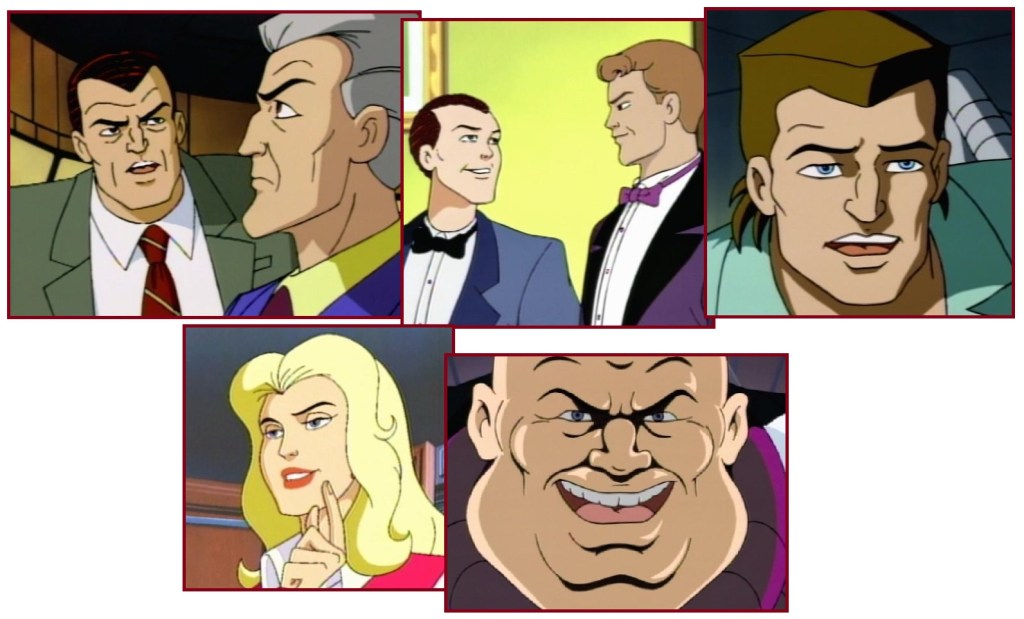
More of Spidey’s large supporting cast make their debuts in this episode. Norman Osborn is voiced by Neil Ross, who also voiced the character in Spider-Man and His Amazing Friends. Spencer Smythe, although he apparently dies in this episode, does indeed make further appearances. However, he is voiced by Edward Mulhare, best known as Devon Miles in Knight Rider. Harry Osborn and Spidey-super fan Flash Thompson also make their debuts. Alistair Smythe is voiced by Grease 2 heartthrob Maxwell Caulfield. Felicia is voiced by Jennifer Hale, X-Men ’97‘s Jean Grey and the Kingpin is voiced by the incredible theatre actor Roscoe Lee Browne – the first African-American to portray the character.
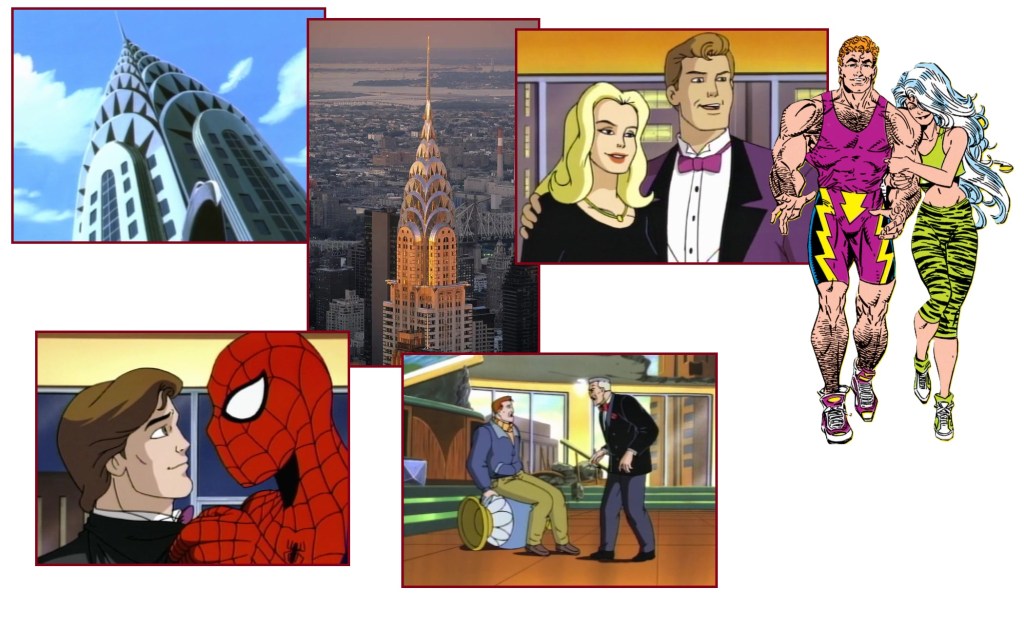
The Chrysler Building, a real-life landmark in Manhattan, serves as the covert headquarters of the Kingpin.
Flash Thompson and Felicia Hardy seem to be dating casually. In the comics, they also had a memorable fling. Speaking of dating, just like the comics, Mary Jane Watson is the subject of a blind date before she appears.
Thwip Quip: Peter and Flash-as-Spidey have the following hilarious exchange:
Peter: “Well what would you like me to say?”
(Flash sees the Black Widow outside the window behind Peter Parker)
Flash: “Ahhhh!”
Peter: “Okay, ahhhh!”
Jonah’s Jibes: To a very-fired Eddie Brock: “You want understanding? See a shrink.”
MAY PARKER: SPIDEY’S CONSTANT GUIDE
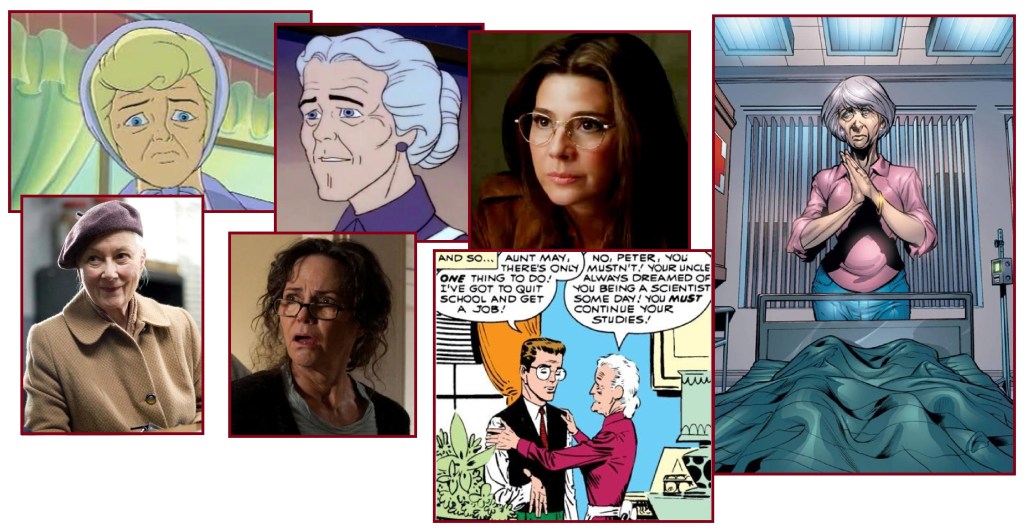
She’s the heart of the story. Not its engine, not its mask — its heart. May Parker first appeared in Amazing Fantasy #15 (1962), the same issue that introduced Peter to the world. From the beginning, she was more than a guardian. She was the emotional compass, the quiet strength behind the chaos. Frail in body, perhaps, but never in spirit. Her love was unconditional, her worry relentless, and her wisdom often overlooked until it was needed most.
In animation, she’s a constant — sometimes comic relief, sometimes dramatic anchor, always present. The 1994 series gave her a gentle dignity, a woman who sensed more than she let on. Later adaptations made her younger, sharper, more active, but the core remained: she is Peter’s tether to humanity. When the world spins out, when the mask begins to blur, it’s Aunt May who reminds him who he is. Not Spider-Man. Peter. The boy who still brings her groceries, still hides his bruises, still tries to protect her from truths she already suspects.
And that’s her power. She doesn’t need to fight crime or swing from rooftops. She holds the line in quieter ways — through casseroles, bedtime stories, and the kind of love that survives grief. Uncle Ben’s death didn’t break her. It refined her. Aunt May isn’t just a supporting character. She’s the reason Peter keeps going. The reason he comes home. The reason he still believes that with great power must come something more than responsibility — it must come love.





 X-Cess Minutiae
Leave a comment