


Return of the Spider-Slayers begins with humour — Spider-Man and J. Jonah Jameson, chained together by a bomb, bickering through chaos. It’s classic juxtaposition: the hero and the critic forced into proximity, their dynamic both absurd and revealing. But beneath the comedy, the episode simmers with darker truths. Alistair Smythe, grieving and consumed by vengeance, has surpassed his father’s legacy in mechanical brilliance — but not in emotional clarity.
His upgraded Spider-Slayers are marvels of design, but his strategy is fractured. He targets too many enemies, spreads his rage too thin, and burns too hot. Flash, Eddie, Norman, Jonah, Spider-Man — each becomes a symbol of his loss, and in trying to punish them all, he loses control. His obsession doesn’t sharpen him; it destabilises him.
And yet, Smythe isn’t alone in this spiral. Kingpin watches from the shadows, not as a mentor but as a manipulator. He sees Smythe’s pain as a tool, a resource to be exploited until the job is done. There’s no empathy in his offer — only utility. Smythe becomes another cog in Fisk’s empire, and the moment he fails, he’ll be discarded like the machines he builds.
Norman Osborn, too, plays his part in the shadows. His dealings with Oscorp’s security and his evasive manoeuvres hint at deeper corruption. He survives this episode, but the seeds of his downfall are already sown. One day, his secrets will catch up with him — and the cost will be personal.
This episode is a study in obsession and control. Smythe wants revenge. Kingpin wants results. Norman wants distance. But Spider-Man, caught in the middle, reminds us that heroism isn’t about power — it’s about restraint. And in the end, it’s Smythe’s inability to let go that ensures his future will only get worse.
Spider-Man’s swing through the city is cut short when the Black Widow Spider Slayer — presumed destroyed months ago — launches a surprise attack. He disables it quickly, but barely catches his breath before the Tarantula Slayer strikes. Two machines, two fronts, and two watchers: Alistair Smythe and Kingpin observe from afar. Peter tags both Slayers with tracers, but Alistair reactivates the Widow mid-fight. Spider-Man is overwhelmed, knocked unconscious, and dragged into Smythe’s lab.
Alistair calls J. Jonah Jameson with a promise: Spider-Man, captured. But when Jameson arrives, he’s taken too. Smythe binds them together with a bomb set to detonate in one hour — vengeance for his father’s death. He vows to target Flash Thompson, Eddie Brock, and Norman Osborn next. Spider-Man and Jameson are dumped back into the city, ticking.
The Black Widow locks onto Flash at ESU. Spider-Man and Jameson arrive just in time. Peter uses the Widow’s own lasers to sever the bomb’s tether from Jameson, then disables the Slayer again. Jameson calls Norman with a warning. Across town, Eddie Brock is mid-interview when the Tarantula crashes in. Spider-Man fries its circuits with a jolt of electricity. Eddie loses the job — and swears revenge.
At Oscorp, Alistair unveils the Scorpion Slayer. Norman’s security drones engage, but Spider-Man — still strapped to the bomb — arrives in the crossfire. Alistair reactivates the Widow and Tarantula, merging all three into a towering Mega Slayer. Norman flees in his car, but the machine gives chase. Spider-Man breaks free of the bomb and pursues.
On the bridge, Norman lies unconscious. Spider-Man rescues him, then climbs the Mega Slayer and plants the bomb. It detonates. The machine falls. Norman stirs. Kingpin watches from the shadows and makes his move — Alistair now works for him, until Spider-Man is dead.
Back home, Peter mends his costume. Aunt May reminds him of his blind date. He opens the door. Mary Jane Watson stands there, radiant. “Face it, Tiger,” she says. “You just hit the jackpot.”
ROGUE’S GALLERY
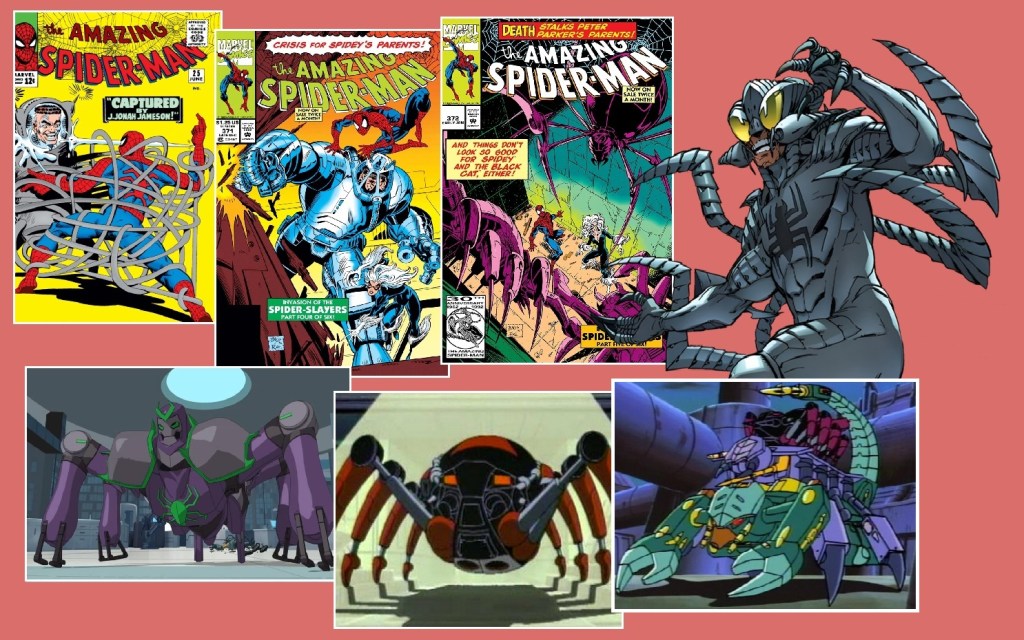
THE SPIDER SLAYERS
They weren’t just machines. They were vendettas in metal casing, born from Spencer Smythe’s obsession and J. Jonah Jameson’s paranoia. The first Spider Slayer lumbered into The Amazing Spider-Man #25 (1965) with a camera for a face and a singular mission: destroy the wall-crawler. It failed, but the blueprint endured — a legacy of engineered hatred masquerading as justice.
Alistair Smythe took that legacy and twisted it. Where his father saw invention, Alistair saw transformation. Each new model was faster, crueler, more personal. And when the machines weren’t enough, he reshaped himself into the Ultimate Spider Slayer — a grotesque fusion of man and mechanism, driven by vengeance and grief. In animation, especially the 1994 series, the Slayers became escalation incarnate: insectoid beasts deployed by Kingpin and Osborn, tearing through the city with surgical precision.
But beneath the circuitry lay something more insidious — a mirror to Peter’s own ingenuity, warped by obsession. The Slayers weren’t just enemies to be outwitted; they were reminders that every heroic act could be studied, countered, weaponised. Even in defeat, they left behind schematics. A legacy of pursuit. A warning that Spider-Man’s greatest battles would never be fought in costume alone.

Several months have passed since the last episode. Mary Jane Watson makes her first appearance right at the episode’s conclusion, referencing her entrance in Amazing Spider-Man #42.
Spider-Man and Jameson end up shackled to a bomb together by a Smythe in Amazing Spider-Man #192, but it’s Spencer rather than Alistair.
Spider-Man uses his spider-tracers for the first time in this episode.
Thwip Quip: To (who-else) Jameson: “Forget it, JJ. he’s not playing with a full deck. You should understand that.”
Jonah’s Jibes: To Alistair: “Why don’t you attach yourself to this bomb and leave me out of it?”
MARY JANE WATSON: THE WOMAN BEHIND THE HERO
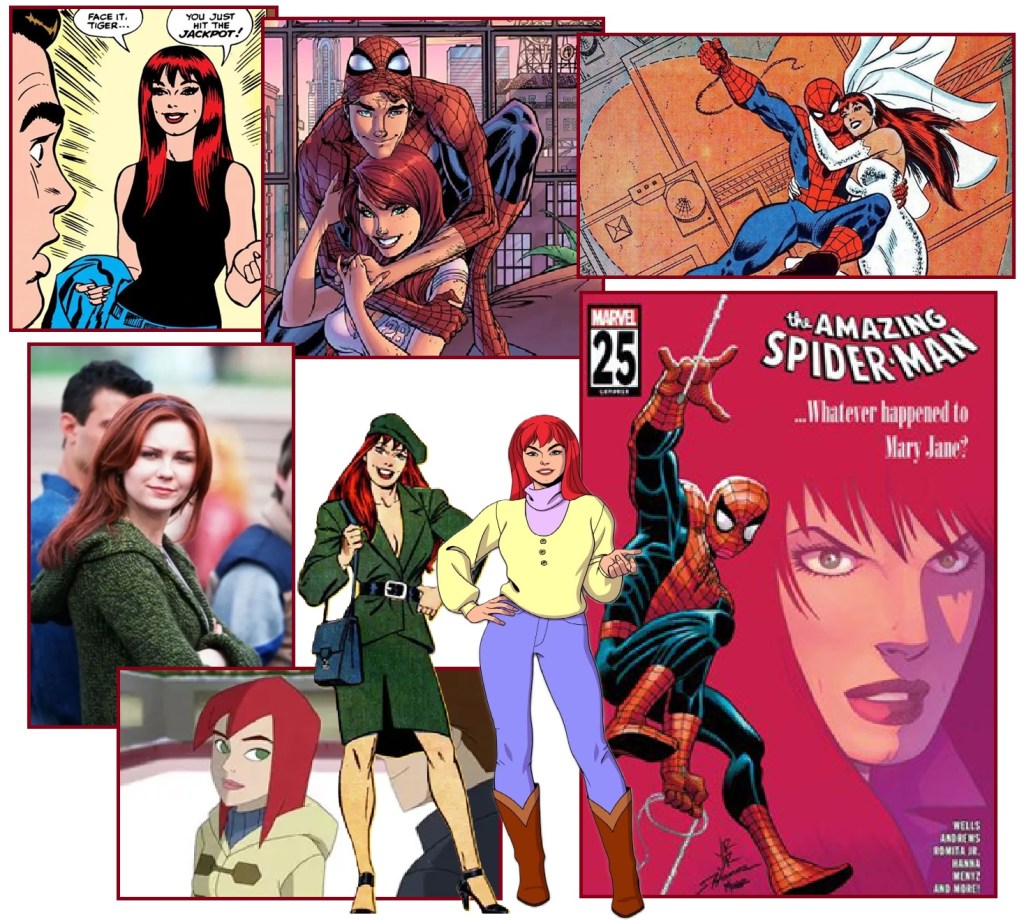
Mary Jane Watson enters the Marvel mythos not with a whisper, but with a door swing and a line that rewrites the rhythm of Peter Parker’s world: “Face it, Tiger… you just hit the jackpot.” But before that iconic moment, she’s a phantom presence — teased, obscured, and postponed. First mentioned in Amazing Spider-Man #15 (1964), MJ doesn’t fully appear until issue #42, her face hidden for over two years as a running gag. When she finally steps into frame, it’s not just a reveal — it’s a statement.
Initially cast as the carefree party girl, MJ is the foil to Gwen Stacy’s more grounded presence. But beneath the surface, she’s already more than a stereotype. Her early appearances are laced with performative charm — a mask of her own — and it’s only after Gwen’s death (ASM #121–122) that MJ’s emotional depth begins to surface. She stays with Peter in his grief, not out of obligation, but out of understanding. That moment reframes her: not just a love interest, but a partner who sees through the mask.
Throughout the Bronze Age, MJ evolves into a central figure in Peter’s life. Their relationship is tested, rekindled, and ultimately solidified in Amazing Spider-Man Annual #21 (1987), when they marry — a controversial but defining moment that anchors Peter’s dual identity in something real. MJ becomes the emotional constant in a life of chaos, balancing her own career as a model and actress with the weight of loving a man who might not come home.
The 1990s and early 2000s test that bond. From stalkers and miscarriages to the infamous One More Day retcon (2007), which erases their marriage from continuity, MJ’s role is repeatedly rewritten — but never erased. Even when sidelined, she remains the emotional echo of Peter’s better self.
On screen, MJ’s legacy fractures and refracts. Kirsten Dunst’s portrayal in Sam Raimi’s Spider-Man trilogy channels the classic redhead with girl-next-door vulnerability and stage-door dreams. Zendaya’s “MJ” in the MCU (Homecoming – No Way Home) reinvents the archetype — sharp, guarded, and emotionally precise — a modern echo of the same truth: she sees Peter, not just Spider-Man.
Across comics and adaptations, Mary Jane Watson endures not because she’s perfect, but because she’s real. She’s the one who stays when the mask comes off.
The jackpot isn’t the kiss or the costume — it’s the connection.




 X-Cess Minutiae
Leave a comment