


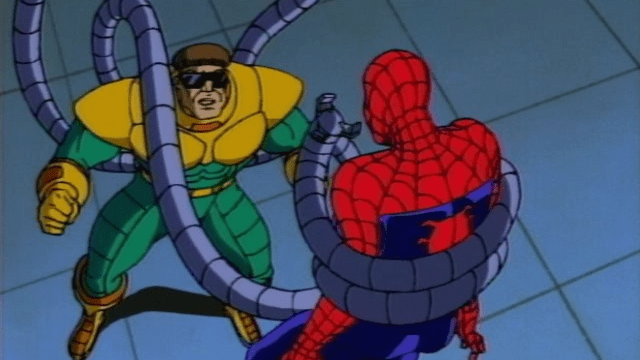
Bringing in Otto Octavius might seem like a safe bet. He’s one of Spider-Man’s most enduring rogues — a tentacled terror with decades of animated history behind him. Sometimes he’s the Master Planner, orchestrating grand schemes. Sometimes he’s a punchline, flailing in his own arrogance. But Armed and Dangerous reconfigures the archetype. This isn’t just a villain. This is a tragedy.
For the first time in Spider-Man’s animated canon, Otto is Peter’s teacher. His mentor. His intellectual guide. And that shift reframes everything. When the accident comes — when the arms fuse and the mind fractures — it’s not just a supervillain origin. It’s a fall from grace. The body horror is softened for Saturday morning, but the emotional pain is palpable, carried in the weary, wounded voice of Efrem Zimbalist Jr. This Otto isn’t a stereotype. He’s a man broken by his own brilliance.
And it’s not Spider-Man’s fists that save the day. It’s Peter’s mind. His empathy. His refusal to see Otto as just another enemy. The climax hinges not on brute strength, but on intellect — a rare inversion that honours Peter’s scientific soul.
There’s sympathy here, foreshadowing the path Raimi’s Spider-Man 2 would later take with Alfred Molina’s unforgettable portrayal. When Otto quotes Richard Lovelace — “Stone walls do not a prison make…” — it’s not just poetic flourish. It’s a promise. That somewhere beneath the metal and madness, the man remains.
And he’ll be free, sooner than we think…
Peter finally lands a date with Felicia Hardy and arrives at her mansion, nervous but hopeful. Outside, Doctor Octopus infiltrates the grounds. Felicia steps away for a jacket — and is taken. Peter is buried under rubble. When he wakes, the FBI dismisses his story until Anastasia Hardy arrives and recognises the ransom note’s signature: Otto Octavius.
Peter flashes back to childhood, remembering Octavius as the scientist who first inspired him. Meanwhile, Felicia is held at a warehouse where Octopus recounts his origin — denied funding by Anastasia, forced into unsafe conditions, and fused to his mechanical arms in a lab explosion. Now, he wants revenge.
Jameson broadcasts a plea. Octopus responds, demanding Jameson deliver the ransom himself. Spider-Man follows, but the fight goes badly. Octopus doubles the ransom and takes Jameson hostage. After pressure from Anastasia and Robbie, Peter persuades the Bugle to let him negotiate.
Octopus shows Peter his fusion reactor, then hurls him out the window when he demands the hostages be freed. Peter returns as Spider-Man, magnetises Octopus’ arms — but triggers an assembly line that threatens Felicia and Jameson. He distracts Octopus with the fusion battery and rescues them just in time.
Back in civilian clothes, Peter slips away as Felicia searches for him. In prison, Octopus vows he won’t be there long.
ROGUE’S GALLERY
DOCTOR OCTOPUS
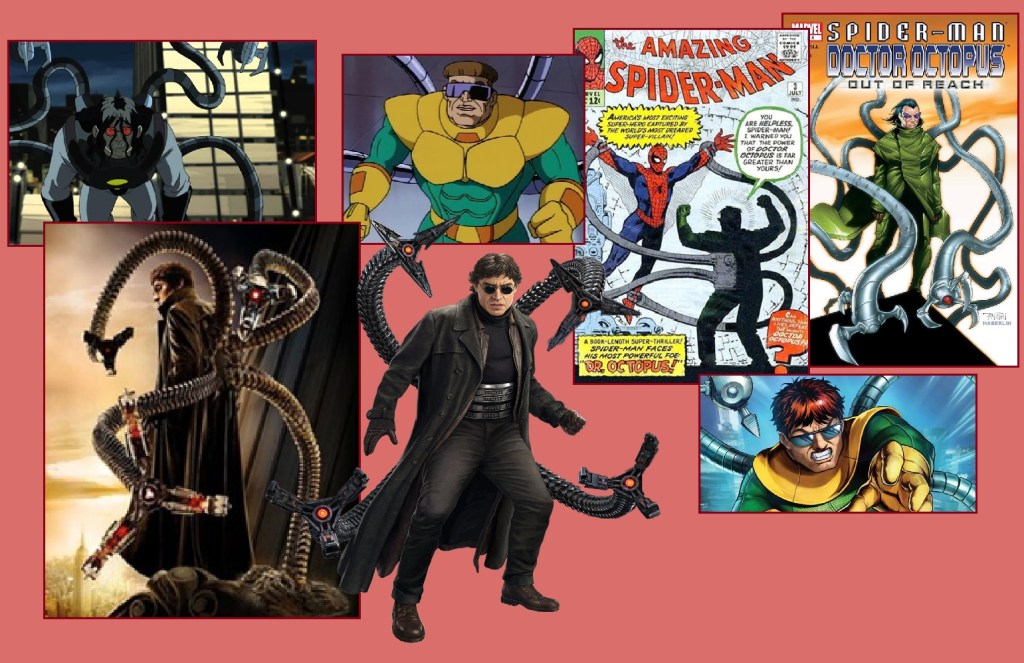
He wasn’t born a villain. Otto Octavius was a scientist first — brilliant, isolated, and aching to be understood. But brilliance without empathy curdles quickly. When a lab accident fused his mechanical arms to his spine, something snapped. Not just bone or nerve — something deeper. In The Amazing Spider-Man #3 (1963), he emerged not as a man recovering from trauma, but as Doctor Octopus: arrogant, unrepentant, and terrifyingly efficient.
What makes him dangerous isn’t the tentacles. It’s the mind behind them. Otto sees himself as superior — not just to Spider-Man, but to the world. His intellect is a weapon, his ego a fortress. And yet, there’s tragedy in his descent. He was once a mentor figure, a man who believed in the power of science to uplift. But rejection, isolation, and unchecked pride turned him inward. In animation, especially the 1994 series, he’s a recurring force: calculating, theatrical, and always one step ahead. A villain who doesn’t chase chaos — he orchestrates it.
Even in defeat, Octavius lingers. His legacy runs deep, from sinister alliances to body-swapping horrors. He’s the kind of enemy who forces Peter to think harder, fight smarter, and confront the uncomfortable truth: that genius alone isn’t enough. That without humility, even the brightest minds can become monsters. Doctor Octopus isn’t just a threat. He’s a warning.

Anastacia Hardy, Felicia’s mother, makes her first appearance in this episode. She’s based on Lydia Hardy, the comic book character’s counterpart, but they’re very unlike each other. Hardy is later proven to be a false name to protect both her and Felicia from her father’s past. In this episode, she’s voiced by fabulous Golden Girl Rue McClanahan.
Efrem Zimbalist Jr, who voices Doctor Octopus (as well as the Hardy’s butler in the show’s opening) is also the voice behind Alfred, Batman’s butler in Batman: The Animated Series.
Thwip Quip: “I really hate to interrupt a megalomaniac when he’s on a roll, but here’s web in your eyes!”
Jonah’s Jibes: Straight at Spidey: “You web headed foul up!”
FELICIA HARDY: THE GWEN STACY SUBSTITUTE

She wasn’t introduced as a thief or a vigilante — she was introduced as competition. In Spider-Man: The Animated Series, Felicia Hardy arrives not as a comic book echo, but as a reimagined college classmate: poised, blonde, and immediately drawn to Spider-Man. Not Peter Parker. Spider-Man. Her fascination is mythic, romantic, and selective — and when Peter hesitates, when he disappears mid-date or dodges intimacy, Felicia reads it as abandonment. The mask becomes the man she wants. The boy beneath it becomes a disappointment.
Felicia’s rivalry with Mary Jane isn’t catty — it’s architectural. Where MJ is warmth and spontaneity, Felicia is elegance and control. Her mother, no longer a quiet civilian, is recast as a powerful business tycoon, adding layers of status and expectation to Felicia’s world. She moves through campus like someone raised to win, and yet her vulnerability is real. She wants connection, but only on her terms. Her attraction to Spider-Man is rooted in mystery and power — not partnership. And that tension makes her dangerous, even before she ever breaks a law.
The black gown she wears to formal events isn’t just fashion — it’s foreshadowing. A visual whisper of the woman she might become. But in these early episodes, Felicia is still circling the flame. Not yet transformed, not yet unleashed. She’s the rival who doesn’t need to sabotage — she simply exists, and that’s enough to shift the emotional gravity. In a series built on dual identities, Felicia Hardy is the rare character who falls in love with the mask first — and never quite forgives the man behind it.





 X-Cess Minutiae
Leave a comment