


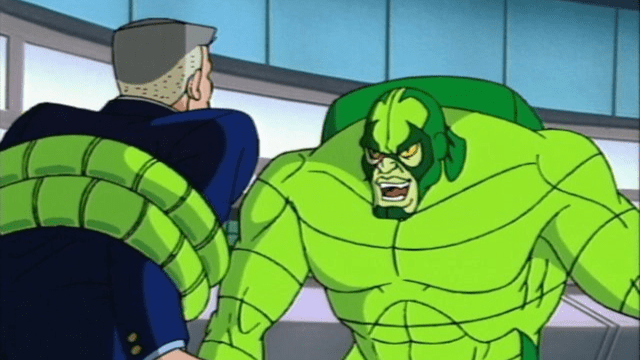
The Sting of the Scorpion is a cautionary tale wrapped in a monster-of-the-week format — a story not just about mutation and menace, but about obsession, grief, and unintended consequences. At its core is J. Jonah Jameson, a man so consumed by his hatred of masked vigilantes that he bankrolls the creation of one. It’s not Spider-Man who creates the Scorpion — it’s Jonah. And the irony bites hard.
Jonah’s vendetta isn’t just professional. It’s personal. The series quietly threads in the loss of his wife, a tragedy that fuels his distrust of heroes who hide behind masks. He sees Spider-Man not as a saviour, but as a symbol of chaos — a reminder that power without accountability can destroy lives. So when he funds Mac Gargan’s transformation, it’s not just a gamble. It’s an attempt to control the narrative. To build a weapon that can unmask the myth.
But control is an illusion. Gargan’s mutation is irreversible, his rage uncontainable. The Scorpion isn’t a tool — he’s a tragedy. And Jonah, for all his bluster, is left to confront the monster he helped create. Spider-Man, once again, is forced to clean up someone else’s mess. But this time, the fallout is personal. The episode doesn’t just challenge Peter’s heroism — it challenges Jonah’s humanity.
By the end, the sting isn’t just physical. It’s emotional. Jonah’s crusade against masks has birthed a new one — more dangerous, more unstable, and entirely his fault. The Sting of the Scorpion reminds us that vengeance disguised as justice will always backfire. And sometimes, the greatest threat isn’t the villain in the shadows — it’s the man who thinks he’s doing the right thing.
Peter walks Felicia Hardy home, but senses they’re being followed. He slips away, suits up, and chases the stalker — only to stumble into a robbery. He stops the crooks but loses the trail. At the Bugle, Peter hands off the photos to Robbie. Jameson arrives, suspicious as ever, and Peter spots the stalker heading into his office. It’s Mac Gargan — a private investigator hired by Jameson to uncover how Peter gets his Spider-Man shots.
Peter eavesdrops, then confronts Jameson in costume, warning him to back off. The encounter triggers Jameson’s buried grief — memories of his wife Julia, assassinated by a masked man. Jameson and Gargan head to ESU, where Professor Stillwell uses the Neogenic Recombinator to splice Gargan’s DNA with a scorpion’s. The transformation is brutal. Gargan becomes the Scorpion.
Jameson sets him loose on Spider-Man. The fight is vicious. Scorpion nearly unmasks Peter before his mutation worsens, turning on Jameson’s helicopter. At the Bugle, Jameson watches the chaos unfold and confesses to Robbie: his hatred of masks stems from trauma, but he’s created a new monster. Spider-Man searches the city. At ESU, Scorpion bursts in, demands reversal, and kidnaps Jameson.
Peter calls Aunt May, cancels lunch, and tracks them to Oscorp. Scorpion plans to use the nuclear reactor to cure himself, risking the city. Spider-Man battles him inside the facility. The reactor destabilises. Peter electrocutes Scorpion while Jameson halts the meltdown. But Jameson’s stance remains unchanged — Spider-Man is still a menace.
That night, Peter runs into Felicia. She agrees to dinner. The mask stays on. The tension deepens.
ROGUE’S GALLERY

THE SCORPION
He was built to be a weapon. Not born, not bitten, not cursed — built. Mac Gargan was a private investigator with a mean streak, hired by J. Jonah Jameson to uncover Spider-Man’s secrets. But when that failed, Jameson doubled down, funding an experiment that fused Gargan with scorpion DNA. The result was monstrous. In Amazing Spider-Man #20 (1965), Scorpion burst onto the page — stronger than Spider-Man, faster, and utterly unhinged.
The transformation shattered whatever conscience Gargan had left. The tail wasn’t just a weapon — it was a tether to rage, to instability, to a mind that couldn’t reconcile what it had become. Scorpion wasn’t a villain with a plan. He was a force of destruction, lashing out at Spider-Man, Jameson, and anyone who reminded him of what he’d lost. In animation, especially the 1994 series, he’s a tragic bruiser — manipulated, mutated, and discarded. A cautionary tale wrapped in green armour.
And yet, he endures. Not because he’s clever, but because he’s relentless. Scorpion is the kind of enemy who doesn’t need finesse — just proximity. He’s a reminder that some threats don’t come from grand schemes or cosmic stakes. Some come from bad decisions, made by men who should’ve known better. Mac Gargan wasn’t born to be a monster. But once the tail fused to his spine, there was no going back.
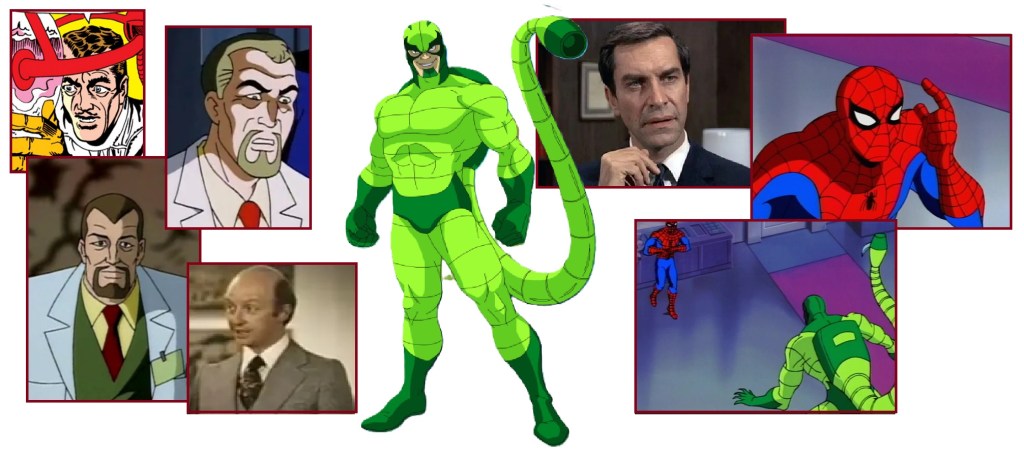
Farley Stillwell, who made his first comics appearance in Amazing Spider-Man #20, mentions that Curt Connors has warned him about the consequences of using the Neogenic Recombinator. Connors accidentally transformed himself into the Lizard with the device in Night of the Lizard. He’s one of the only comic villains to appear in the 1970s live action series.
The Scorpion is voiced by acting legend Martin Landau. of Mission: Impossible fame.
Thwip Quip: To Jonah, whilst saving his life: “Look, if we continue to meet like this tongues will begin to wag.” There’s also this one, to anger the Scorpion: “You don’t like names huh. That’s too bad frogface. Cause to me your nothin’ but a two bit, no account, second rate, sewer breath, baboon with the brain of a pigeon and the face of an eel.”
J. JONAH JAMESON: THE LOUDEST VOICE
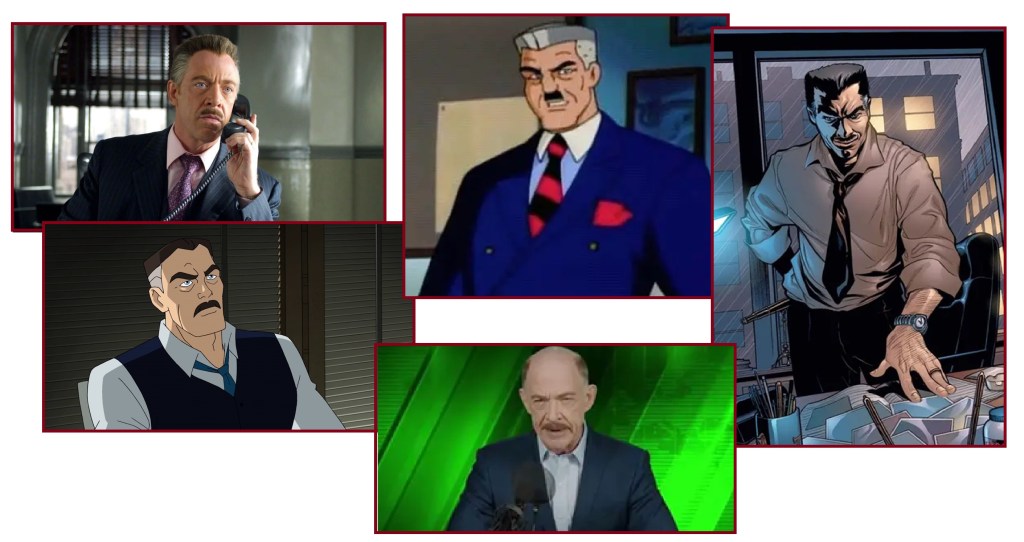
He’s the voice of the city — loud, relentless, and utterly convinced he’s right. J. Jonah Jameson first appeared in The Amazing Spider-Man #1 (1963), and from that moment, he’s been Peter Parker’s most consistent antagonist without ever throwing a punch. He doesn’t need superpowers. He has a printing press. A platform. A belief that Spider-Man is a menace, and that truth is whatever he says it is. His crusade isn’t just personal — it’s institutional.
Jameson is more than bluster. Beneath the shouting and cigar smoke is a man who genuinely believes in accountability, even if his methods are warped by ego. In animation, especially the 1994 series, he’s a fixture — barking orders at Robbie Robertson, berating Parker, and offering rewards for photos that confirm his bias. And yet, there’s nuance. He’s a father to John, a reluctant ally when the stakes demand it, and occasionally, a man who admits he might be wrong — though never for long.
That’s his power. Jameson doesn’t need to be liked. He needs to be heard. He’s a reminder that perception shapes reality, that the loudest voice can drown out the truth, and that even heroes must contend with public opinion. He’s not a villain. He’s a force. And in Peter’s world, that makes him one of the most enduring threats — and one of the most human.




 X-Cess Minutiae
Leave a comment