


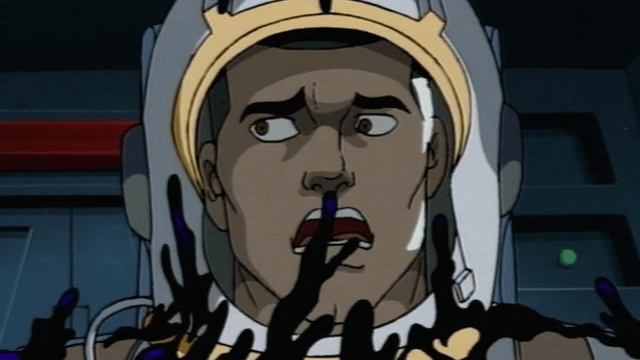
This is the turning point. The Alien Costume (Part 1) marks the beginning of Spider-Man’s descent — not into villainy, but into something darker, more primal. The arrival of the symbiote isn’t just a costume change. It’s a personality fracture. The episode plays it slow at first: enhanced strength, improved agility, a new edge to Peter’s voice. But the shift is unmistakable. By the time he’s poised to kill the Rhino, the mask isn’t just black — it’s hungry.
The line “That’s funny, I give up too. I give up trying to be a friendly neighbourhood Spider-Man.” lands like a gut punch. It’s the first time the phrase is spoken in the series — and it’s laced with irony. Peter isn’t surrendering to despair. He’s surrendering to power. The symbiote amplifies everything: his anger, his ego, his need to be seen. And the city, which once feared him, now has reason to.
His confrontation with Flash Thompson bristles with tension. The usual schoolyard rivalry is replaced by something colder, more dangerous. Felicia’s reaction — “You are different. You scare me.” — cuts deeper than any punch. It’s not just that Peter’s changed. It’s that the people around him can feel it. The flash of Venom in his reflection is more than foreshadowing. It’s a warning. The monster isn’t coming. It’s already here.
This episode isn’t about the suit. It’s about identity. About what happens when Peter stops pulling his punches — emotionally, physically, morally. The symbiote doesn’t corrupt him. It reveals him. And what it reveals is terrifying. Part I ends not with a cliffhanger, but with a question: if power feels this good, why would anyone give it up?
On an asteroid, John Jameson uncovers a black rock — Promethium X — that begins to ooze and quake. He escapes just in time. Back on Earth, Peter, Jameson and Robbie watch the shuttle’s return. Kingpin and Alistair Smythe also take interest. On the George Washington Bridge, Eddie Brock is stuck in traffic as the ooze escapes containment and forces the shuttle to crash.
Rhino arrives first. Spider-Man rescues the astronauts but sees Rhino stealing the Promethium X. He tags him with a tracer, but Eddie — seeing only fragments — blames Spider-Man. Jameson, desperate for answers, reinstates Eddie in exchange for the photos. Spider-Man crawls from the river, unaware the ooze has bonded to him.
The tracer fails. Rhino delivers the Promethium X to Kingpin. Aunt May watches the news — Spider-Man is now wanted. Jameson offers a million-dollar reward. Peter throws his costume in the wardrobe, but the ooze seeps out and covers him. He dreams of being consumed by a black monster and wakes hanging upside down in a new black suit.
The suit enhances his powers. It responds to thought, even disguising him as a police officer to evade capture. The next day, Peter uses it to impress Felicia, but when Flash provokes him, Peter lashes out — scaring them both. The aggression is growing.
Alistair needs control rods to test Promethium X. Kingpin sends Rhino. After arguing with Aunt May, Peter sees the tracer reactivate and tracks Rhino to a government facility. Spider-Man thrashes him, nearly killing him with an iron door — before pulling back, shaken by what he’s becoming.
ROGUE’S GALLERY
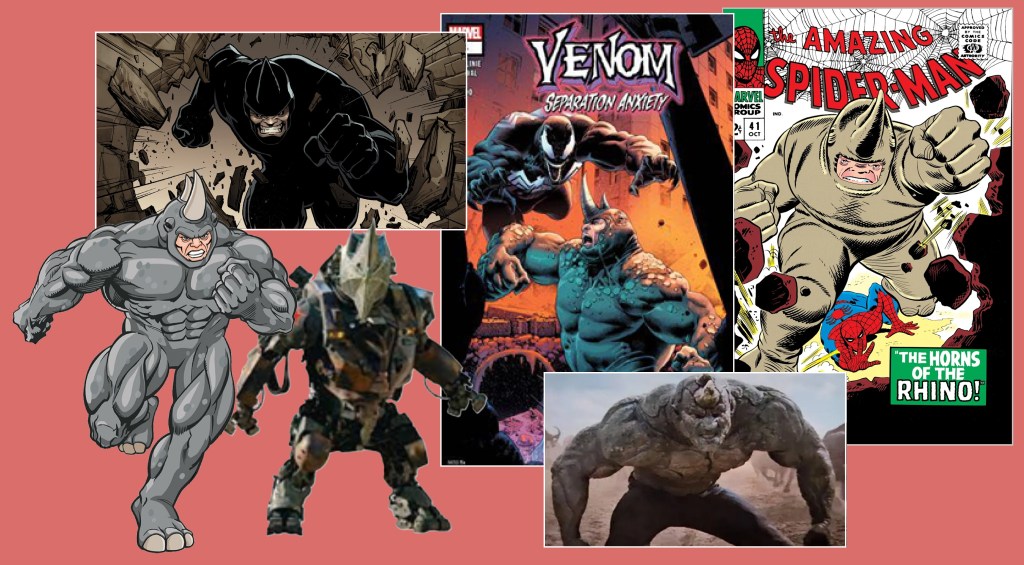
RHINO
He was built for impact. Aleksei Sytsevich wasn’t a mastermind or a mutant — he was muscle, desperate and disposable. When he first charged into Amazing Spider-Man #41 (1966), it was as a hired brute encased in an experimental polymer suit, fused to his skin and shaped like a charging beast. Strength beyond measure. Speed that defied physics. But no way out. The Rhino wasn’t just a weapon — he was a prison.
What makes him tragic isn’t the violence. It’s the simplicity. Aleksei never wanted power. He wanted escape — from poverty, from obscurity, from being the man nobody noticed. The suit gave him that, but at a cost. In animation, especially the 1994 series, Rhino is portrayed as a blunt instrument: loyal to whoever pays, angry at whoever mocks, and always crashing through walls he doesn’t understand. He’s not stupid, but he’s trapped — by design, by circumstance, by the very armour that made him matter.
And yet, he endures. Not because he evolves, but because he refuses to vanish. Rhino is the kind of villain who reminds Peter that not every enemy is a genius or a monster. Some are just men who were used, altered, and abandoned. And when they charge, it’s not for conquest. It’s for recognition. For revenge. For the chance to matter again — even if it means breaking everything in their path.
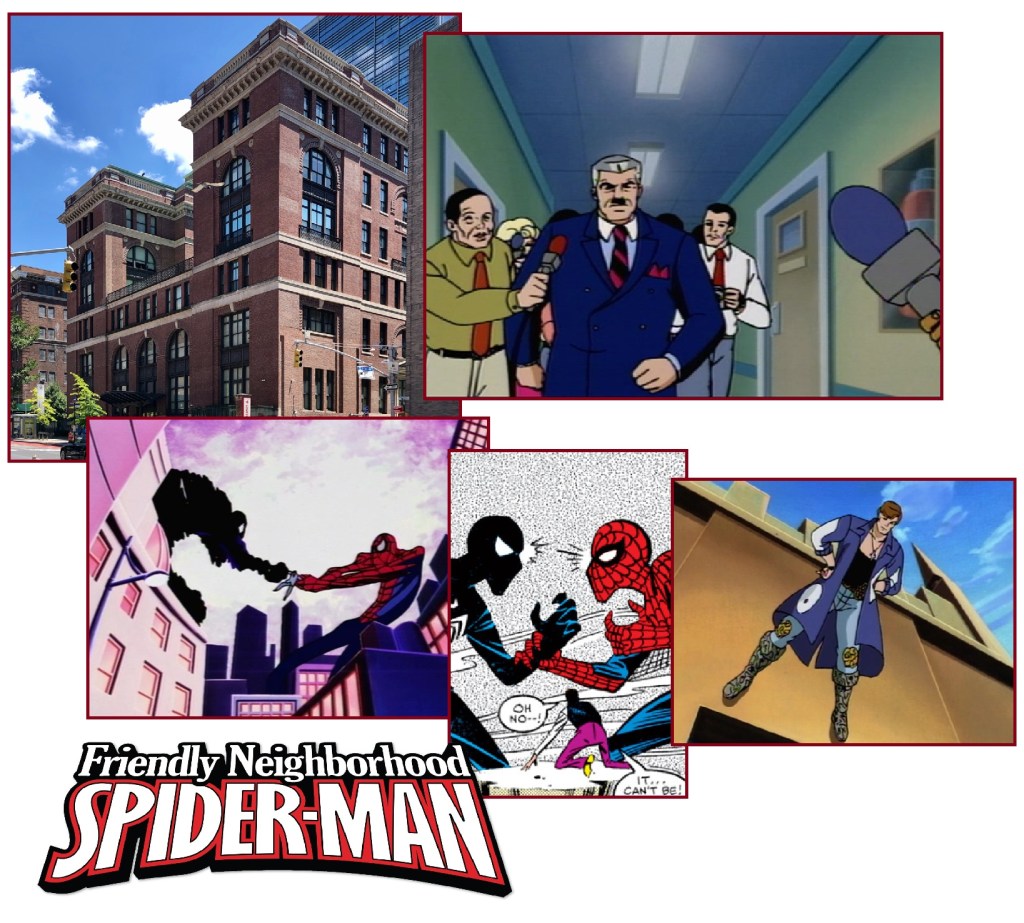
Bellevue Hospital is a real hospital in Manhattan.
The dream sequence in which the symbiote and Spider-Man’s costume battle for control over Peter Parker is inspired by Amazing Spider-Man #258.
When Peter changes his clothes to reflect ‘that guy from Aerosmith,’ a snippet from the theme music plays. His clothes resemble Aerosmith guitarist’s Joe Perry – who performs the theme.
This is the first time the catchphrase ‘Friendly neighbourhood Spider-Man’ is quoted.
Thwip Quip: Spidey’s comments on the cleanliness of the Hudson River: “That’s some river pollution. Rich and creamy.”
Jonah’s Jibes: Jonah’s desperation (and rage) shines through: “I’ll take ’em Brock. I finally got that wall crawling sack of garbage.”
JOHN JAMESON: ASTRONAUT HERO

He was a hero before Peter ever put on the mask. John Jameson debuted in The Amazing Spider-Man #1, not as a rival or a threat, but as a symbol of courage — a test pilot, a son of the city, and the pride of J. Jonah Jameson. His spacecraft spiralling out of control was the first crisis Spider-Man ever faced publicly, and saving him marked Peter’s arrival as a hero. But for John, that rescue was the beginning of something far more complicated.
John’s journey is one of transformation — not just physical, but existential. In the comics, he becomes the Man-Wolf, cursed by a lunar gemstone that turns him into a savage creature. In animation, especially the 1994 series, he’s a decorated astronaut caught in the crossfire of alien symbiotes and political manoeuvring. He’s brave, loyal, and often manipulated — a man trying to live up to expectations while wrestling with forces beyond his control. His relationship with his father is strained, defined by pride and disappointment, and his connection to Peter is layered with gratitude, rivalry, and unspoken respect.
And that’s what makes him compelling. John Jameson isn’t just a supporting character — he’s a mirror. A man who’s done everything right, and still finds himself overshadowed by a masked vigilante. He represents the cost of heroism without powers, the weight of legacy without myth. Whether piloting shuttles or battling inner demons, John is always reaching — for honour, for identity, for a place in a world that keeps rewriting the rules.
Doctor Octopus: Armed and Dangerous | The Alien Costume (Part 2)




 X-Cess Minutiae
Leave a comment