


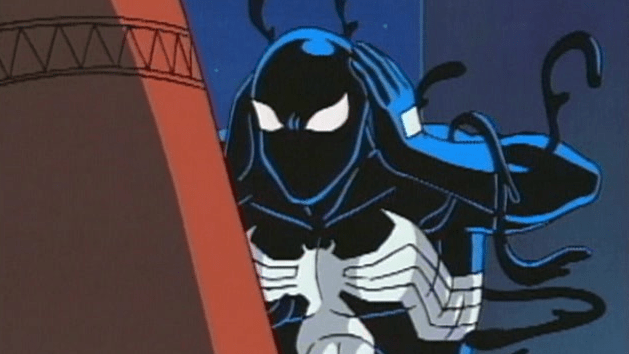

If Part I was the descent, then Part II is the intoxication. Peter revels in the symbiote’s power — swinging faster, hitting harder, and losing sight of the line he swore never to cross. The suit doesn’t just enhance him; it isolates him. His quips vanish. His empathy dulls. And the city, once wary, now fears him outright.
The episode thrives on tension: Peter versus Eddie, Peter versus Flash, Peter versus himself. His confrontation with Felicia was especially sharp — she saw the change before Peter did, and her fear cuts through the bravado – and he realises she was right. The symbiote amplifies Peter’s worst instincts, but it also reveals the cost of unchecked power. He’s not just stronger. He’s crueller.
The church bell sequence is mythic — a gothic echo chamber where Peter battles the suit in silence, pain, and desperation. It’s not a fight. It’s an exorcism. And when the symbiote finds Eddie, the real horror begins. The birth of Venom isn’t a transformation. It’s a union of two men broken by Spider-Man.
Part II ends not with resolution, but with dread. Peter is free — but something worse is now watching. Waiting. And it knows him better than anyone.
Spider-Man swings through the city, hunted by civilians chasing Jameson’s million-dollar reward. The black suit fuels his rage, but a sonic weapon from one attacker disrupts the symbiote. At the Bugle, Peter confronts Jameson and Brock over the false Promethium X photos, but security forces him out. Meanwhile, Kingpin and Alistair pitch Promethium X’s explosive potential to buyers.
At ESU, Dr. Curt Connors analyses the suit and confirms it’s a symbiote — a living organism that feeds on its host. Peter refuses to remove it, saying he has unfinished business. At the hospital, John Jameson reveals Rhino stole the Promethium X. Jameson fires Brock and retracts the bounty. Kingpin and Alistair scramble to cover their tracks.
Peter finds Brock’s photo reel proving Rhino’s guilt, but overhears Shocker threatening Brock. He confronts Shocker, who buries him under rubble. Spider-Man escapes, tracks Shocker to Alistair’s lab, and retrieves the Promethium X. Furious, Kingpin orders retaliation. Shocker kidnaps John Jameson and demands a trade. Jameson pleads for Spider-Man’s help. Brock follows, chasing a story.
At the church, Spider-Man hands over the Promethium X. Shocker attacks. Brock intervenes but is webbed up and left dangling. Spider-Man nearly kills Shocker, but Uncle Ben’s memory pulls him back. The symbiote tries to finish the job, but Peter saves Shocker. Realising the suit’s grip, Peter climbs the bell tower. The sonic vibrations weaken the symbiote. He tears it off — and it slithers down to Brock.
Kingpin and Alistair attempt another Promethium X demo, only to find it unstable — just as Spider-Man predicted. Back at the bell tower, the symbiote bonds with Brock. Venom is born.
ROGUE’S GALLERY
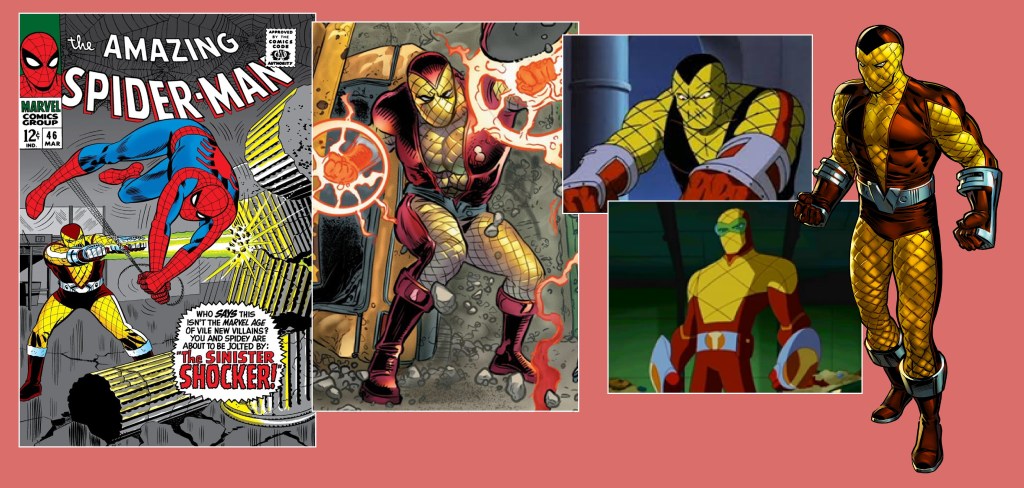
SHOCKER
He wasn’t flashy. No wings, no claws, no radioactive bite. Just gauntlets — crude, brutal, and devastating. Herman Schultz was a small-time crook with a knack for engineering, and when he debuted in Amazing Spider-Man #46 (1967), it was with a suit that could vibrate concrete into dust. The Shocker didn’t want fame. He wanted efficiency. A clean job. A quick score. And if Spider-Man got in the way, he’d be flattened.
But the gauntlets did more than punch holes in walls — they gave Schultz a reputation. Not as a mastermind, but as a survivor. He’s been mocked, underestimated, written off as second-tier. And yet, he keeps coming back. In animation, especially the 1994 series, Shocker is a recurring bruiser — loyal to whoever’s paying, but never quite disposable. His blasts are concussive, his resolve stubborn, and his fear of failure palpable. He’s not trying to conquer. He’s trying to stay in the game.
That’s what makes him linger. Shocker isn’t a villain of vision — he’s a villain of rhythm. A man who knows his limits, but refuses to be erased. He’s the kind of enemy who reminds Peter that not every battle is mythic. Some are just hard. Loud. Relentless. And sometimes, the ones who hit hardest aren’t the ones with grand plans — they’re the ones who never stop swinging.
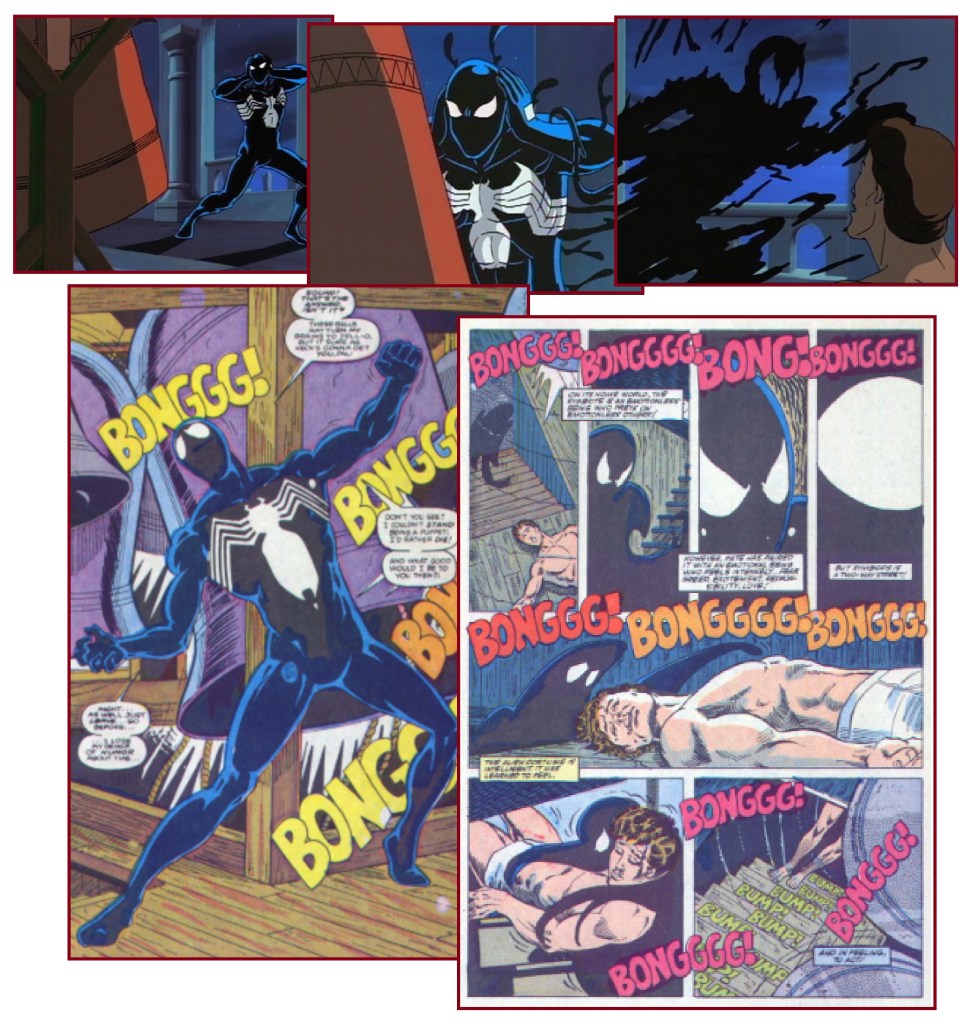
The sequence where Spider-Man uses the bell to get free from the symbiote is adapted from Web of Spider-Man #1.
Thwip Quip: “Since I got my new suit I get invited to all the best parties.” And to Jameson when he asks for help: “So now I’m suppose to come running when you call?”
Jonah’s Jibes: “I think that new suit’s cutting off the oxygen to your brain.” Also, throwing out Brock yet again: “Get me security – I’ve got some trash they can throw out!”
EDDIE BROCK: THE MAN WHO HATED SPIDER-MAN
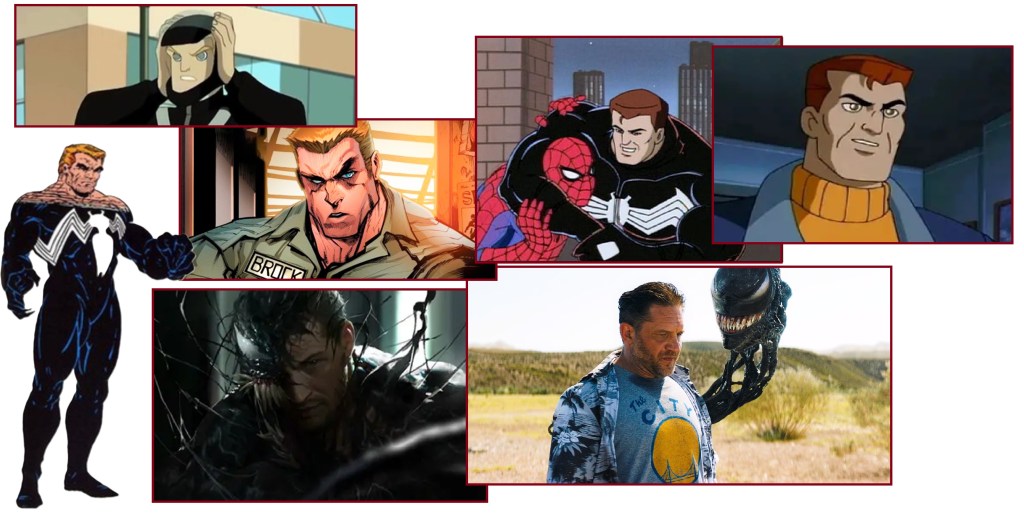
Eddie Brock first appears in Amazing Spider-Man #298 (1988), a shadowed figure with a grudge and a secret. Created by David Michelinie and Todd McFarlane, Eddie is introduced not as a monster, but as a man broken by professional failure and personal shame. A disgraced journalist, he blames Spider-Man for exposing his fraudulent reporting — a misstep that cost him his career and reputation. His bitterness is palpable, his fall from grace deeply human. Before the symbiote ever touches him, Eddie is already a cautionary tale.
In the comics, Eddie’s arc is one of obsession and identity. His hatred for Spider-Man is rooted not in ideology, but in wounded pride. When the alien symbiote bonds with him, it amplifies his rage and gives him power — but it doesn’t heal the man beneath. Over time, Eddie’s relationship with the symbiote evolves, and so does his character. He becomes an anti-hero, a protector of the innocent, even a cancer patient seeking redemption. But the core remains: Eddie Brock is a man who cannot let go of what he lost.
On screen, Eddie’s journey fractures and refracts. In Spider-Man 3 (2007), Topher Grace plays him as a smug rival to Peter Parker — more caricature than character, lacking the emotional weight of the comics. The 2018 Venom film, with Tom Hardy in the role, reimagines Eddie as a scrappy investigative journalist with a conscience. This version leans into Eddie’s vulnerability and moral ambiguity, crafting a buddy dynamic with the symbiote that’s more comedic than tragic. It’s a departure, but it captures something essential: Eddie is not evil. He’s just lost.
In animation, Eddie’s portrayal varies. Spider-Man gives him a slow-burn arc — a friend turned enemy, manipulated by circumstance and rage. His transformation into Venom is earned, and his hatred for Spider-Man feels personal. Later series, like Spectacular Spider-Man (2008), refine this further, showing Eddie as a loyal friend betrayed by Peter’s secrecy. Across media, Eddie Brock remains a mirror — not of Spider-Man’s power, but of his consequences. He’s the fallout. The echo. The man who reminds us that truth, when mishandled, can destroy.





 X-Cess Minutiae
Leave a comment