


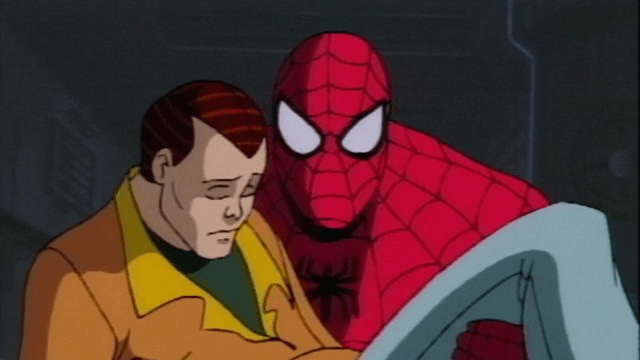
This episode takes Part I and escalates everything. The Hobgoblin doesn’t just attack — he conquers. Fisk Tower falls. Kingpin retreats. And for a moment, the Hobgoblin becomes the Kingpin of Crime. It’s a bold move, and it reveals the truth: this villain isn’t just theatrical. He’s tactical. And he’s holding Harry Osborn hostage.
Norman’s duplicity deepens. His refusal to act, his cryptic promises, and his eventual alliance with Kingpin paint him as a man playing both sides. Spider-Man, caught in the middle, is forced to navigate a maze of lies, traps, and shifting loyalties. The hidden tunnel sequence is classic espionage — a hero infiltrating the heart of villainy, not with brute force, but with resolve.
The final battle is layered: Spider-Man versus Hobgoblin, Kingpin versus chaos, Harry versus captivity. And when the building burns, it’s not just infrastructure that collapses — it’s the illusion of control. Hobgoblin escapes, but his empire crumbles. Kingpin reclaims his throne. And Norman, ever the survivor, watches it all unfold.
The episode ends with emotional fallout. MJ wonders where Peter is. Harry is traumatised. And Spider-Man, exhausted, confronts Norman one last time — only for Hobgoblin to return. The river crash isn’t closure. It’s a pause. Because this goblin always comes back.
Spider-Man survives Hobgoblin’s smart bombs by escaping through the sewers. The fight continues until Hobgoblin bombs a car and assumes the hero is dead. Meanwhile, Hobgoblin storms Fisk Tower. Peter confronts Norman at Oscorp, demanding answers. Norman insists it’ll be resolved by midnight. Peter checks in on Aunt May and MJ at the hospital.
At Fisk’s base, Hobgoblin turns on Kingpin. Despite an ambush, he unleashes his upgraded glider and claims the criminal empire. Still holding Harry hostage, Hobgoblin demands Oscorp. Kingpin and Smythe reappear, revealing a secret tunnel between their base and Oscorp. Norman proposes using Spider-Man to take Hobgoblin down.
At midnight, Spider-Man arrives and strikes a deal with Norman. He infiltrates the base via the tunnel while Norman and Kingpin approach separately. The fight with Hobgoblin destroys the tech infrastructure. Spider-Man rescues Harry. Hobgoblin escapes as Kingpin reclaims his throne. Traps are triggered, but Spider-Man and Harry escape.
Back at Oscorp, MJ wonders where Peter is. Spider-Man confronts Norman. Hobgoblin returns, seeking revenge. The final battle ends with Hobgoblin crashing into the river. Peter arrives at the hospital just in time to see Aunt May wake. He and MJ decide they’re not ready to move out — not yet.
ROGUE’S GALLERY

THE KINGPIN
He doesn’t wear a mask. He doesn’t need one. Wilson Fisk entered The Amazing Spider-Man #50 (1967) not as a costumed menace, but as a businessman with fists like wrecking balls and a mind sharper than most heroes ever realise. He’s the Kingpin of Crime — a title earned, not inherited — and his power doesn’t come from gadgets or mutations. It comes from control. Of people. Of systems. Of fear.
Fisk is a paradox: brutal and refined, monstrous and meticulous. In animation, especially the 1994 series, he looms large — literally and figuratively — orchestrating chaos from penthouses and boardrooms, often pulling strings behind the likes of Smythe, Hobgoblin, or the Insidious Six. He rarely throws the first punch, but when he does, it lands like a declaration. His strength is matched only by his patience. He doesn’t chase Spider-Man. He waits for the moment Peter’s world is vulnerable — then strikes.
And that’s what makes him terrifying. Kingpin isn’t just a villain. He’s infrastructure. A reminder that corruption doesn’t always wear claws or cackle from rooftops. Sometimes it wears silk, speaks softly, and owns the building you’re trying to save. Fisk doesn’t want to destroy Spider-Man. He wants to outlast him. To prove that in the long game, power isn’t about heroism. It’s about permanence.
THE MYSTERY OF THE HOBGOBLIN
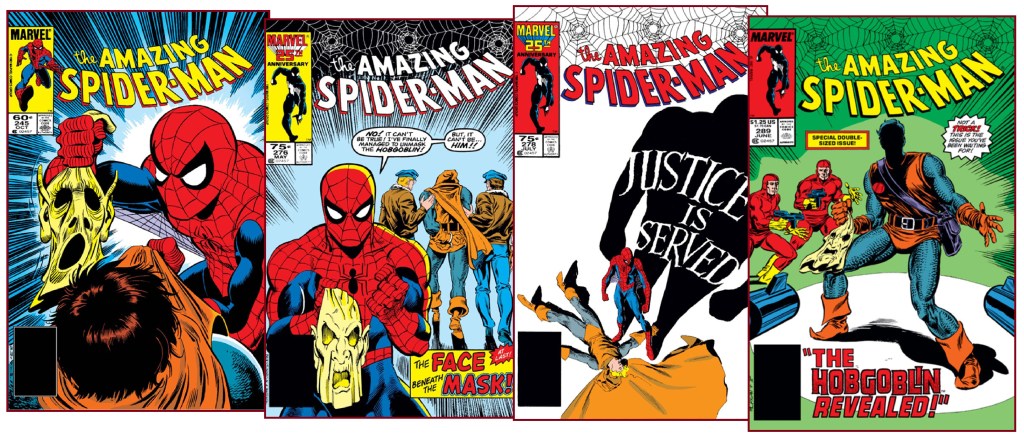
The Hobgoblin first appears in Amazing Spider-Man #238 (1983), created by Roger Stern and John Romita Jr. From the outset, he’s a mystery — a new villain who steals Norman Osborn’s Goblin tech but operates with colder precision and strategic flair. Unlike the Green Goblin’s madness, the Hobgoblin is calculating, corporate, and anonymous. His identity becomes one of the longest-running enigmas in Spider-Man history, teased across years of issues, red herrings, and editorial reshuffles.
In the comics, the mystery of the Hobgoblin’s true identity was deliberately prolonged. Readers speculated wildly: was it Ned Leeds, Richard Fisk, Flash Thompson, or someone else entirely? The reveal was muddled by behind-the-scenes changes, with Ned Leeds initially framed as the Hobgoblin posthumously, only for later retcons to establish Roderick Kingsley — a fashion tycoon — as the true mastermind. Kingsley’s reveal in Spider-Man: Hobgoblin Lives (1997) finally closed the loop, but the damage was done. The Hobgoblin’s mystery had become a meta-narrative about editorial control and the cost of delay.
The 1994 animated series takes a different path. The Hobgoblin is introduced before the Green Goblin, voiced with theatrical menace by Mark Hamill. His identity is never a mystery — he’s Jason Philip Macendale, a mercenary with a taste for chaos and a contract with Kingpin. The show sidesteps the comic’s whodunnit entirely, opting instead for a clear, charismatic antagonist who destabilises the city’s power structures and torments Norman Osborn long before Norman dons the Goblin mask himself.
This clarity serves the ensemble well. The animated Hobgoblin isn’t a puzzle — he’s a disruptor. His presence forces Kingpin, Norman, and Spider-Man into uneasy alliances and emotional recalibrations. While the comics leaned into suspense, the series leans into impact. And in doing so, it trades mystery for momentum — a choice that reshapes the Goblin legacy and gives the Hobgoblin his own mythic weight.




 X-Cess Minutiae
Leave a comment