


THE NEOGENIC NIGHTMARE
Chapter I
This is escalation. The Insidious Six doesn’t just reintroduce Spider-Man’s rogues — it weaponises them as a collective, a conspiracy forged by Kingpin to crush a hero already faltering. The episode marks the moment Peter’s powers begin to betray him, turning every swing into doubt, every punch into pain. Vulnerability becomes the theme, and the mask — once a symbol of strength — is now a fragile shield against predators who sense weakness.
The gathering of villains is more than spectacle. It’s a statement: Spider-Man’s enemies are learning, adapting, and uniting. Rhino’s brute force, Shocker’s precision, Mysterio’s illusions, Scorpion’s rage, Chameleon’s deception, and Octavius’s intellect — together they represent every facet of Peter’s struggle. Individually, he has beaten them. Collectively, they embody the nightmare of being outnumbered, outmanoeuvred, and outmatched.
What makes the episode sting is not the fight itself, but the erosion of identity. Spider-Man slips while wallcrawling, nearly plummets to his death, and realises his powers are no longer reliable. The hero who once defined himself by agility and resilience is suddenly fragile. His enemies don’t just attack his body — they attack his confidence, his sense of self. The Six are less a team than a mirror, reflecting Peter’s fear that he is losing control of the very gift that makes him Spider-Man.
The episode isn’t about villains uniting. It’s about the cost of weakness. It asks what happens when the hero’s greatest strength begins to fail, and whether identity can survive when stripped of power. The Insidious Six is the opening note of Season Two’s darker symphony: Spider-Man is no longer climbing walls with ease. He is clinging to them, desperate not to fall.
The Kingpin convenes his fellow crime lords to celebrate a profitable year, though Silvermane remains dissatisfied, with Spider-Man still a thorn in their side. Silvermane briefly restrains the Kingpin, but Fisk breaks free and announces a new operation designed to eliminate Spider-Man once and for all.
In prison, the Chameleon receives word from Alistair Smythe that the Kingpin is orchestrating his escape. Ordered to free Mac Gargan, Quentin Beck, and Shocker, the group then release Rhino and Doctor Octopus from their cells. The six fugitives flee by helicopter and are formally united by the Kingpin as the Insidious Six. Though hesitant, even Doctor Octopus agrees to join the plan to destroy Spider-Man.
Meanwhile, Peter discovers his powers are faltering, slipping mid-wallcrawl and narrowly avoiding disaster. Exhausted, he sleeps through an entire day before arriving late to class, where Dr. Curt Connors announces a contest for a research assistant. Felicia Hardy invites Peter out, but Flash Thompson interrupts with news of villains wreaking havoc. Spider-Man confronts the Six, nearly defeated due to his weakened state, but escapes aboard a passing train.
Seeking answers, Peter turns to Connors, who explains that his DNA is mutating further from the original spider bite. This leaves Peter late for Felicia, who instead spends time with Michael Morbius after he rescues her from muggers. The Insidious Six then lure Spider-Man by deceiving Aunt May, claiming Peter has collapsed and been taken to “Dr. Octavius’s clinic.” Returning home, Peter finds a note threatening May’s safety unless Spider-Man complies. He tracks the ruse to a warehouse disguised by Mysterio, where he is confronted by the Insidious Six.
ROGUE’S GALLERY
THE SINISTER SIX
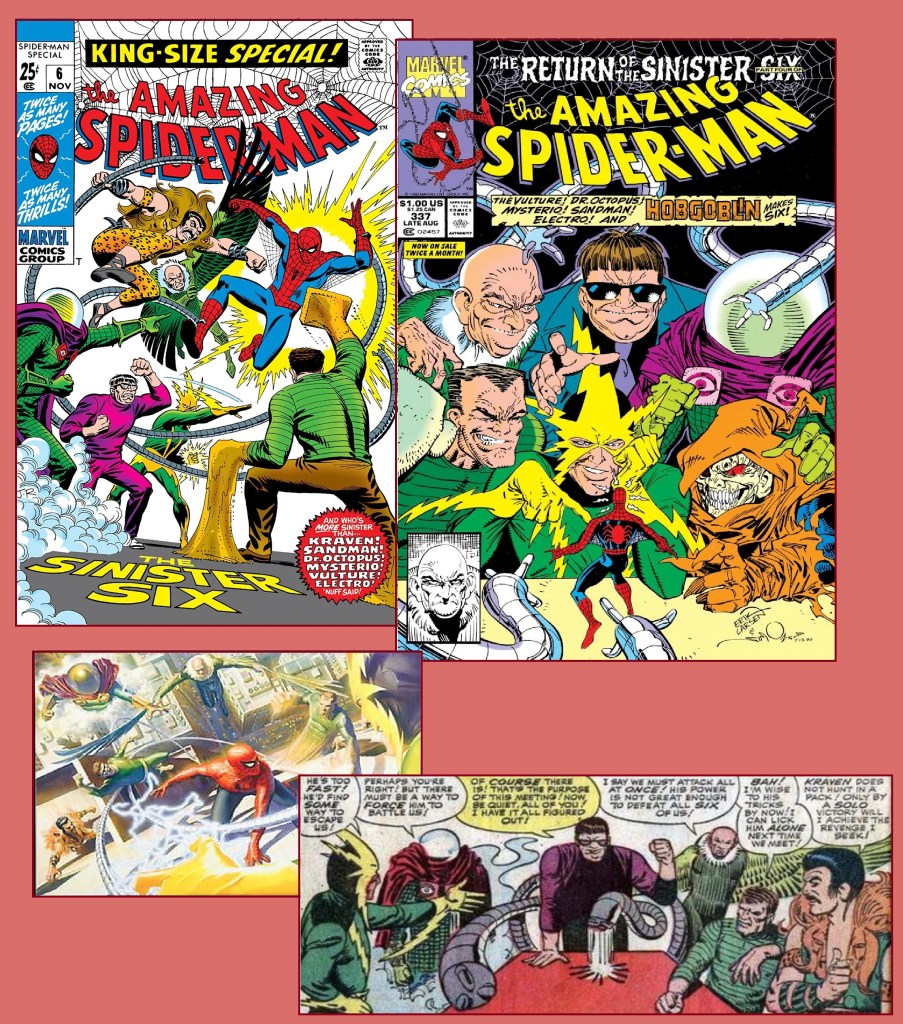
The Sinister Six first appear in Amazing Spider-Man Annual #1 (1964), with Doctor Octopus assembling Vulture, Electro, Kraven, Mysterio, and Sandman to finally destroy Spider-Man. It’s the first true villain team-up in Marvel, but their egos and rivalries ensure failure even as they showcase Spidey’s resilience.
In comics, the Six recur with shifting membership — Hobgoblin, Venom, Shocker, and others — but the pattern remains: formidable alone, undone together. Their identity is less about unity than escalation, proving Spider-Man’s rogues can’t resist trying to overwhelm him collectively.
On screen, the Six are teased more than realised. The 1994 series uses villain ensembles but never the full roster. Spectacular Spider-Man embraces the concept directly, while Sony’s Amazing Spider-Man 2 teased their arrival without payoff. The MCU’s No Way Home brought five villains together, but not the classic Six.
The Sinister Six endure as a symbol of scale. They represent the moment Spider-Man’s enemies stop being personal rivals and become a collective threat — only to collapse under their own obsession. Their failures are their myth, and their persistence ensures they remain one of Spidey’s most iconic ensembles.

The episode is based on the first appearance of the Sinister Six, from Amazing Spider-Man Annual #1.
The Toomes Foundation is mentioned – a prelude to the namesake’s Vulture in Shriek of the Vulture.
The word ‘insidious’ is used instead of ‘sinister’. This was not due to censorship, but rather writer John Semper stating that they were not the same team – he used different characters.
Briefly in this episode, amongst the many crime bosses, long-time Daredevil adversary the Owl, can be seen.
Thwip Quip: To Chameleon, who’s disguised as Spidey at the time: “Aren’t you a handsome gent.” Also when Doc Connors asks him where he got his powers from, Spidey retorts back immediately with this gem: “I won them on a quiz show.” He claims his category was neogenics.
DEBRA WHITMAN: COLLEGE COLLEAGUE
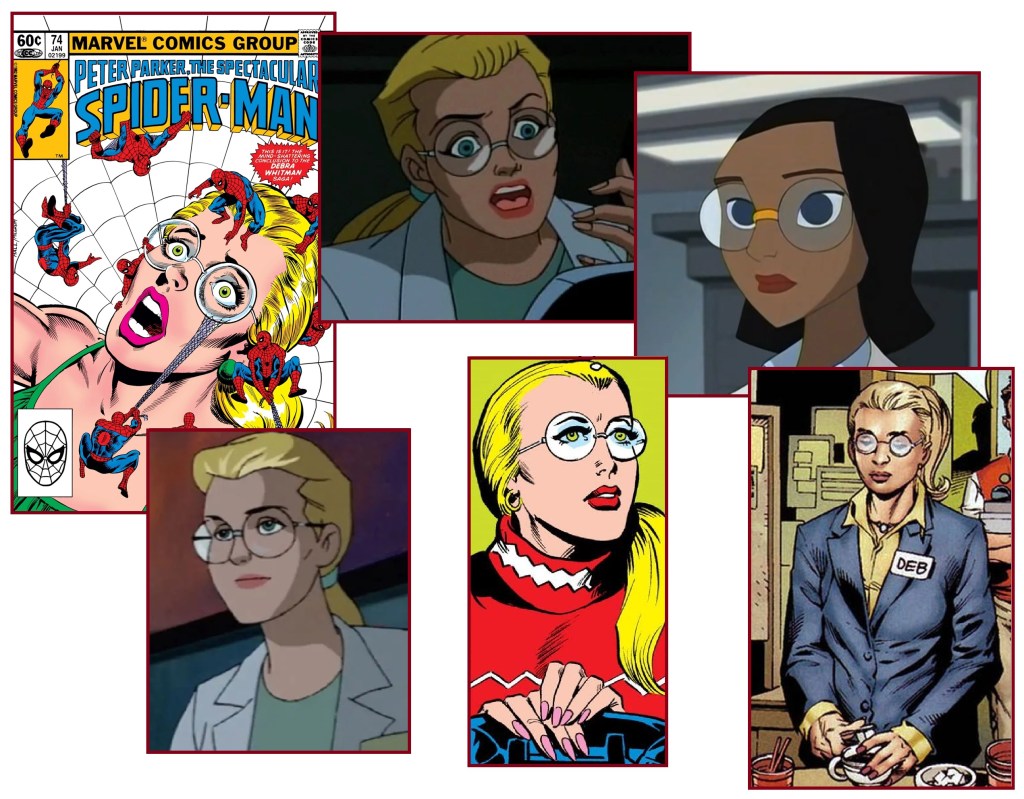
Debra Whitman first appears in Spectacular Spider-Man #46 (1980), created by Bill Mantlo and Jim Mooney. She is introduced as Peter Parker’s colleague at Empire State University, a kind-hearted secretary who quickly becomes a friend and confidante. Her role is grounded in everyday life, offering Peter a sense of normalcy outside the mask.
In the comics, Debra develops feelings for Peter, but their relationship is complicated by his double life. Her suspicion that he is Spider-Man grows into a fragile belief, one that Peter cruelly confirms during a period of stress. The revelation shatters her, and she eventually leaves New York, later writing a memoir about her experiences. Debra’s arc highlights the collateral damage of Peter’s secrecy and the emotional cost of being close to him.
On television, Debra appears in Spider-Man: The Animated Series, reimagined as a scientist working alongside Curt Connors. This version is more assertive and professional, contributing to the series’ scientific ensemble rather than serving as a romantic subplot. Her presence adds depth to the supporting cast, grounding the show’s exploration of mutation and research.
Debra Whitman has not appeared in live-action film, but her legacy endures as a reminder of Spider-Man’s human connections. She represents the ordinary lives touched — and sometimes broken — by Peter’s choices, embodying the theme that even without villains, his double identity carries profound consequences.




 X-Cess Minutiae
Leave a comment