



THE NEOGENIC NIGHTMARE
Chapter II
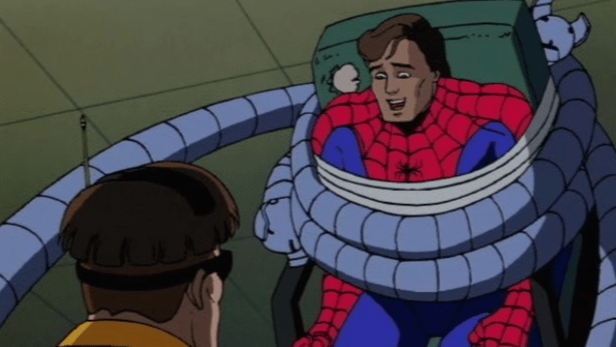
Battle of the Insidious Six takes the unmasking of Spider-Man — the ultimate exposure — and twists it into denial. Octavius, the man who knows Peter best as both rival and mirror, looks at him and refuses to believe. To Doc Ock, Peter’s weakness proves he cannot be Spider-Man. It’s a cruel irony: the truth revealed, then immediately erased. The mask is gone, but the identity remains hidden, not through cunning, but through failure.
The episode thrives on perception. To the Six, Peter is a pretender in costume. To Silvermane, Kingpin is a liability. To Aunt May, Peter is a boy in danger. Every character sees what they want to see, and every conclusion is wrong. The theme is mistrust — not just between hero and villain, but within the criminal empire itself. The underworld fractures, alliances splinter, and war erupts. Kingpin’s empire is shaken not by Spider-Man’s strength, but by the illusion of weakness.
For Peter, the battle is more internal than external. His powers continue to falter, his confidence erodes, and his enemies grow bolder. Yet it is precisely his fragility that saves him. Octavius dismisses him, the Six underestimate him, and Peter survives by being overlooked. It’s a paradox: the hero is protected not by strength, but by doubt.
This episode isn’t about victory. It’s about survival through misinterpretation. It asks what happens when identity is stripped bare, and whether being underestimated can be as powerful as being feared. Battle of the Insidious Six leaves Spider-Man not triumphant, but invisible — a hero whose greatest weapon, for now, is the world’s refusal to believe in him.
Spider-Man confronts the Insidious Six but, weakened by his failing powers, is defeated. They unmask him, yet Doctor Octopus dismisses the idea that Peter Parker could be Spider-Man, believing instead he is a pretender in costume trying to save his aunt. With the Six’s “failure” exposed, Silvermane rallies the crime lords and declares war on the Kingpin’s empire.
Kingpin responds by sending Rhino, Shocker, and Scorpion to assault Silvermane’s base, while Chameleon and Mysterio remain hidden in the false “hospital” and Doc Ock releases Aunt May. They warn Peter that unless he delivers the “real” Spider-Man, she will be taken again. Chameleon then impersonates Hammerhead to infiltrate Silvermane’s ranks, before revealing himself, kidnapping Silvermane, and assuming his identity to call off the attack.
Peter lures the Six to a rooftop, claiming it is his usual meeting place with Spider-Man. Using stolen holocubes from Mysterio, he creates a distraction, feigns a fall, and returns moments later as Spider-Man. In the ensuing chaos, Silvermane dangles from Kingpin’s helicopter, but Spider-Man rescues him and secures his escape, eluding the Six in the process.
With their plan in ruins, the Insidious Six disband, leaving Kingpin furious. Peter seeks comfort in Felicia Hardy, only to learn she is now seeing Michael Morbius. Returning home to Aunt May and Mary Jane, he later visits Dr. Curt Connors as Spider-Man, who warns him that his mutation is accelerating — and may soon transform him into something no longer human.
ROGUE’S GALLERY
SILVERMANE
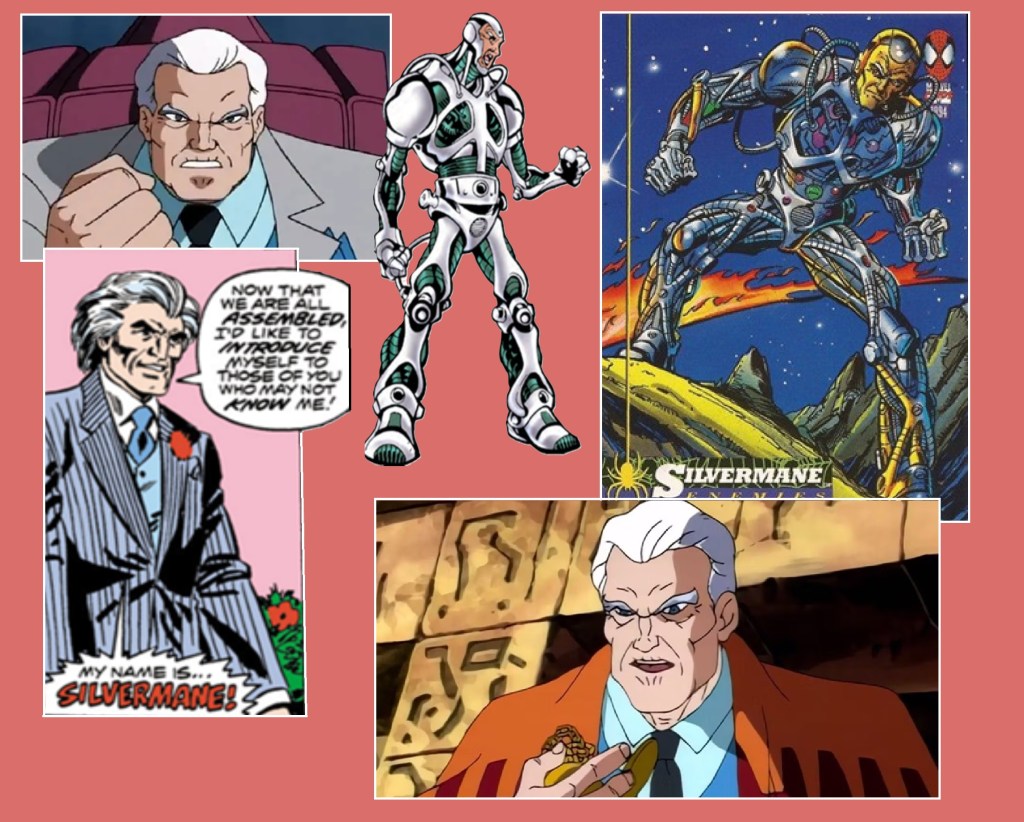
Silvermane first appears in Amazing Spider-Man #73, created by Stan Lee and John Buscema. Born Silvio Manfredi, he is introduced as an ageing crime boss desperate to regain his youth. His obsession with power leads him to ancient artefacts and experimental science, transforming him into a younger, stronger version of himself — though his schemes always collapse under the weight of his ambition.
In the comics, Silvermane becomes a recurring figure in Marvel’s criminal underworld. He leads the Maggia, rivals Kingpin, and clashes with Spider-Man, Daredevil, and others. His pursuit of longevity often backfires, leaving him trapped in mechanical bodies or reduced to a cyborg shell. He embodies the theme of corruption through age and greed — a man who cannot accept mortality and destroys himself trying to escape it.
On television, Silvermane is most memorable in Spider-Man. His arc is striking: an old man restored to youth, only to regress into infancy by the end. It’s a surreal, tragic storyline that highlights his obsession with control and the futility of denying time. Later animated appearances keep him as a Maggia boss, but the ’94 series gives him mythic resonance.
Silvermane has yet to appear in live-action film, though his presence looms in the wider Marvel crime tapestry. Across media, he endures as a symbol of decay and desperation — a villain not defined by flashy powers, but by the inevitability of age and the ruinous lengths he’ll go to defy it.




 X-Cess Minutiae
Leave a comment