



THE NEOGENIC NIGHTMARE
Chapter XII
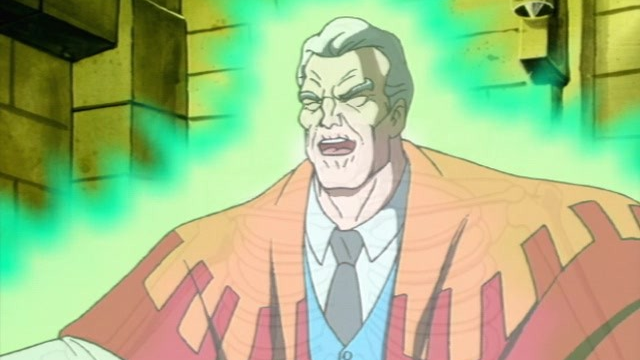
Silvermane, desperate to reclaim youth, finally succeeds — only to discover that time cannot be mastered, only accelerated. His transformation from decrepit crime lord to infant is not victory, but irony. The artefact does not grant eternity. It exposes the futility of trying to outrun mortality.
The theme is corruption through denial. Silvermane refuses to accept the natural end of life, and in doing so becomes undone by the very power he craved. Kingpin, too, is fractured — his empire shaken as Vanessa abandons him, unwilling to endure the cost of his criminal ambition. Even Spider-Man, who once hoped the tablet might cure his mutation, learns that shortcuts to salvation are dangerous. Every character is forced to confront the truth: time cannot be bargained with.
The episode thrives on betrayal. Smythe double-crosses Tombstone, Hammerhead shifts allegiance, and Alisa Silvermane proves as ruthless as her father. Alliances collapse as quickly as they form, each faction consumed by the tablet’s promise. The chaos is not about possession of the artefact. It is about the desperation it reveals — the lengths to which men will go to deny the inevitable.
Ravages of Time is about the cost of obsession. Silvermane’s regression into infancy is the ultimate cautionary tale: immortality is not a gift, but a curse. Kingpin loses his wife, Spider-Man saves lives but gains no cure, and the tablet passes into new hands, its legacy of destruction intact. The episode ends not with triumph, but with inevitability — time always wins.
Spider-Man falls to Tombstone, leaving Dr. Curt Connors captured and delivered to Silvermane, who demands the scientist restore his youth through the Tablet of Time. At the same moment, Alisa Silvermane waits for her date with Peter Parker at the Coffee Bean, only to be kidnapped by Hammerhead and brought before Kingpin. The crime lord, already distraught over Silvermane’s abduction of his wife Vanessa, finds himself caught in a web of betrayal and shifting allegiances.
Smythe confronts Spider-Man through the Mega-Slayer, refusing to believe Connors has been taken by Silvermane. His robot attacks, but Kingpin’s call halts the destruction — an exchange is being arranged. Tombstone sends Connors and Vanessa to the Mega-Slayer, while Alisa and the Tablet are sent in return. Smythe double-crosses them, attempting to seize all hostages, but Tombstone retaliates with a rocket launcher. Though damaged, Smythe revives the robot and secures Vanessa’s return. Hammerhead intervenes, preventing Tombstone from reclaiming Alisa. Spider-Man pursues Hammerhead’s helicopter, saving Alisa, but she immobilises him, unaware she is revealing her identity to Peter Parker himself.
Kingpin rages at Smythe and Hammerhead’s failure, but Smythe discovers a spider-tracer on the Mega-Slayer and reverses it to locate Silvermane’s hideout. There, Silvermane opens the roof to harness the sun’s power, activating the Tablet. The Mega-Slayer enters, only to be destroyed again by Tombstone’s rockets. The tablet succeeds in restoring Silvermane’s youth, but Connors mutates into the Lizard and attacks. Alisa shoots the creature unconscious, but Silvermane’s rejuvenation spirals out of control — his body regresses until he becomes a helpless infant. Alisa orders the hideout destroyed, but Spider-Man rescues Connors and Margaret from the explosion. Hammerhead arrives to claim the tablet amidst the chaos.
In the aftermath, Vanessa tells Wilson Fisk she is leaving him, unwilling to endure his criminal empire any longer. Hammerhead delivers the Tablet of Time to Kingpin, but Fisk orders its disposal. Hammerhead sells it instead to Adrian Toomes, shifting the artefact into new hands and ensuring its legacy of corruption and obsession continues.
ROGUE’S GALLERY

HAMMERHEAD
Hammerhead first appeared in Amazing Spider-Man #113 (1972), created by Gerry Conway and John Romita Sr. He quickly established himself as one of Spider-Man’s most distinctive mobster villains, defined by his steel-reinforced skull and obsession with the style and brutality of 1920s gangsters. His origin is rooted in violence: beaten nearly to death, he was saved and altered by the disgraced surgeon Dr Jonas Harrow, who rebuilt his skull with steel. This gave him his trademark flat, “hammer-like” head and superhuman durability, allowing him to rise through the ranks of the Maggia crime syndicate.
Hammerhead’s stories often revolve around his role as a crime boss rather than a supervillain in the traditional sense. He is a temperamental mobster, frequently clashing with Spider-Man while trying to expand his criminal empire. His loyalty to the Maggia and his fixation on old-school gangster aesthetics make him a unique figure in Marvel’s rogues’ gallery. Over the years, Hammerhead has fought not only Spider-Man but also other crime lords such as Kingpin and Silvermane, often caught in the shifting alliances and betrayals of New York’s underworld. His adamantium-reinforced skull makes him nearly indestructible in combat, though his ambitions often exceed his abilities.
Beyond the comics, Hammerhead has appeared in several animated adaptations. He later appeared in The Spectacular Spider-Man (2008), reimagined as a more modern mob lieutenant. He has also shown up in video games, including Spider-Man: Friend or Foe and Spider-Man: Shattered Dimensions, where his gangster persona and brutal fighting style were emphasised. These appearances cemented Hammerhead as a recurring figure in Spider-Man media, even if he has never reached the iconic status of villains like Green Goblin or Doctor Octopus.
Spidey recognises Silvermane as the ‘old man’ he saved from Doctor Octopus in Battle of the Insidious Six.
Some shots of the Lizard are reused from Night of the Lizard.
Thwip Quip: On Tombstone: “For a walking Mount Rushmore he’s fast.” Also, the rather lowbrow “Hey brick brain!” – aimed at Hammerhead.




 X-Cess Minutiae
Leave a comment