


THE SINS OF THE FATHER
Chapter I
Doctor Strange picks up directly from last season’s cliffhanger, resolving the mystery of Mary Jane’s disappearance and kickstarting another season long arc, this one tantalisingly called ‘The Sins of the Father’.
What begins as a personal crisis for Peter Parker — the anguish of a missing loved one and the blame laid upon him — becomes the gateway into a world far beyond his usual battles. The search for Mary Jane draws Spider-Man into the orbit of Doctor Strange, where sorcery, illusion, and cosmic forces replace the familiar language of crime and mutation.
Spider-Man’s world is one of science, mutation, and street-level struggle, where villains are born of experiments gone wrong or greed unchecked. Doctor Strange’s world is one of mysticism, ancient relics, and battles fought across dimensions. The collision of these realms highlights the difference between rational cause-and-effect and the boundless unpredictability of magic. Where Peter relies on webs and wit, Strange wields spells and artefacts. Yet both fight for the same truth: protecting the innocent from forces that would consume them.
This juxtaposition was used to great effect decades later in Spider-Man: No Way Home, where Peter’s grounded humanity collided with Strange’s cosmic perspective. Here, too, the episode demonstrates how well Spider-Man fits into any situation. He is not a sorcerer, nor a scientist of Connors’ calibre, nor a crime lord like Kingpin. He is the everyman — a young man burdened by responsibility, thrown into battles far larger than himself, and yet always finding a way to endure.
The episode thrives on this tension. Mary Jane’s entrapment in Mordo’s illusions, Peter’s own temptation by visions of his parents, and the looming shadow of Dormammu all underscore the danger of a world where reality itself can be rewritten. Strange may command the mystic arts, but it is Spider-Man’s resilience, his refusal to surrender to despair or deception, that proves decisive.
The episode therefore is about the meeting of worlds — science and sorcery, street-level heroism and cosmic threat. It resolves a cliffhanger with emotional weight, but more importantly, it shows that Spider-Man belongs everywhere. Whether facing gangsters, mutants, or dark lords of other dimensions, he remains the same: the everyman hero, whose strength lies not in magic or mutation, but in his humanity.
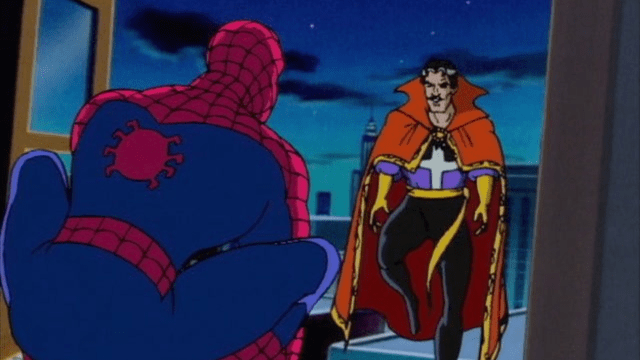
Mary Jane’s disappearance haunts Peter, her aunt blaming him for the loss. His search leads him to masked marauders attacking Wong in Strange’s sanctum. Among them is Mary Jane herself, enthralled by sorcery. Spider-Man is overwhelmed until Doctor Strange intervenes, banishing the attackers before they can seize the Wand of Watoomb. Strange warns Peter to leave this battle to mystics, but Peter’s resolve drives him deeper into danger.
The marauders belong to Baron Mordo, who cloaks his false faith — the Centre for Reunification — in illusions of lost loved ones. Mary Jane is among his devotees, ensnared by visions of her father. Even Peter is deceived, shown his parents and bound to Mordo’s will. With Spider-Man compromised, Mordo’s forces overpower Wong and Strange, stealing the Wand to free Dormammu from exile.
Strange breaks Peter’s enchantment with the Eye of Agamotto, and together they storm Mordo’s stronghold. Strange and Mordo clash in a duel of sorcery, while Spider-Man and Wong battle the enthralled. Peter reclaims the Wand, forcing Mordo to draw upon Dormammu’s power. In desperation, Peter leaps into Dormammu’s realm itself, carrying the relic, and Strange follows to save him. Through cunning and magic, they evade the dark lord and escape back to Earth.
Mary Jane struggles to accept that the fatherly figure she saw was illusion. Dormammu seizes her, attempting to corrupt her with the same deception. Yet she resists, rejecting the false vision, and Dormammu casts her out in fury. Strange seals the portal, restoring her to safety.
Gratitude is exchanged, the Wand secured, but Strange feels the chill of unseen eyes upon them. Victory has been won, yet the sense of looming darkness remains…
ROGUE’S GALLERY
DORMAMMU
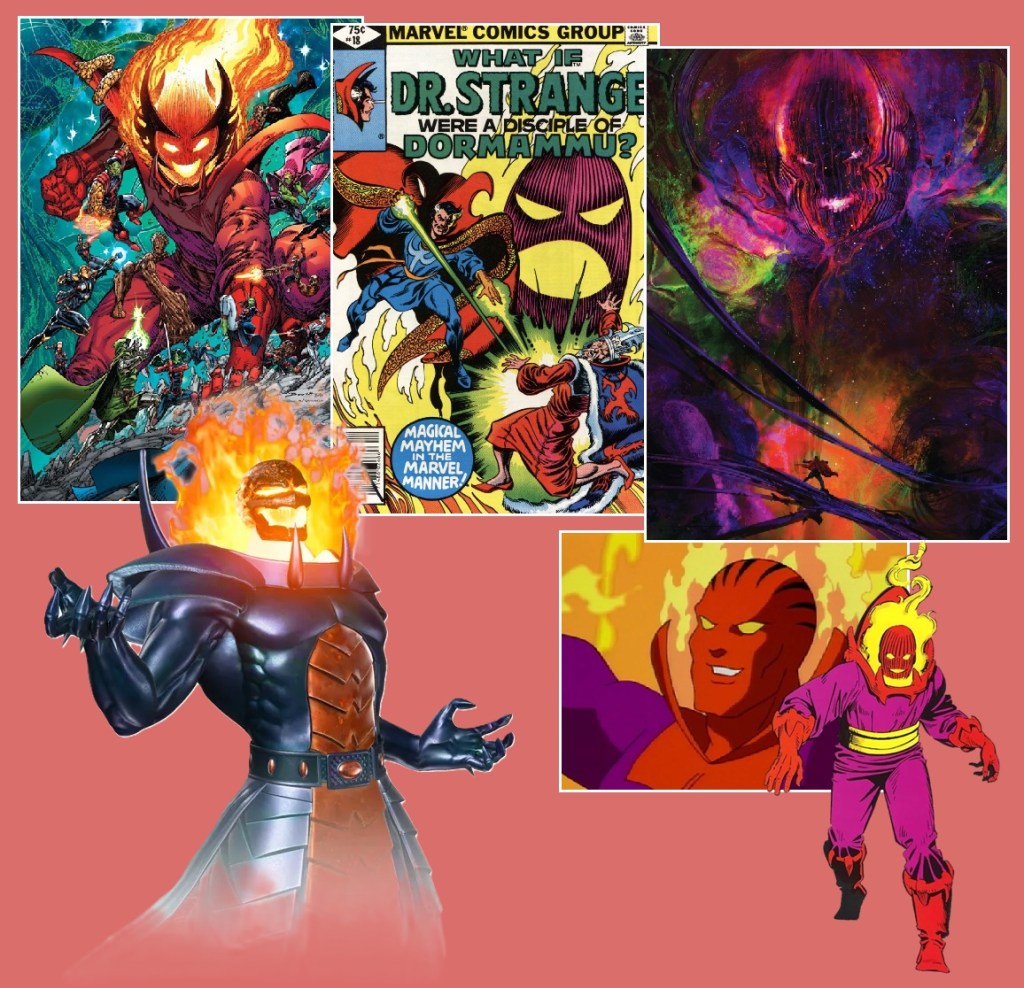
First appearing in Strange Tales #126, created by Stan Lee and Steve Ditko, the Dread Dormammu is a being of immense mystical power from the Dark Dimension. Dormammu is a member of the Faltine race — entities composed of pure energy. Alongside his sister Umar, he conquered the Dark Dimension and established himself as its tyrannical ruler. His ambition has always been conquest: to extend his dominion beyond his realm and enslave Earth, making him one of Doctor Strange’s greatest adversaries.
In the comics, Dormammu is depicted as nearly omnipotent within his own dimension, commanding the Mindless Ones and wielding dark magic capable of reshaping reality. His battles with Doctor Strange are legendary, often forcing Strange to rely on cunning, alliances, and the favour of cosmic entities to resist Dormammu’s overwhelming power. Dormammu’s clashes extend beyond Strange, occasionally involving the Avengers and other heroes when his schemes threaten the wider Marvel Universe.
Dormammu has appeared in multiple adaptations. His most prominent portrayal came in Doctor Strange (2016), where he was realised as a colossal, godlike entity bargaining with Strange in the famous “time loop” confrontation. This cinematic version emphasised his role as a cosmic tyrant, embodying inevitability and dread.
Dormammu endures as the embodiment of chaos and ambition. Where Doctor Strange represents discipline and balance, Dormammu is hunger without end — a force that seeks to consume and corrupt. His presence reminds readers and viewers alike that some battles are not against men, but against the very concept of darkness itself.
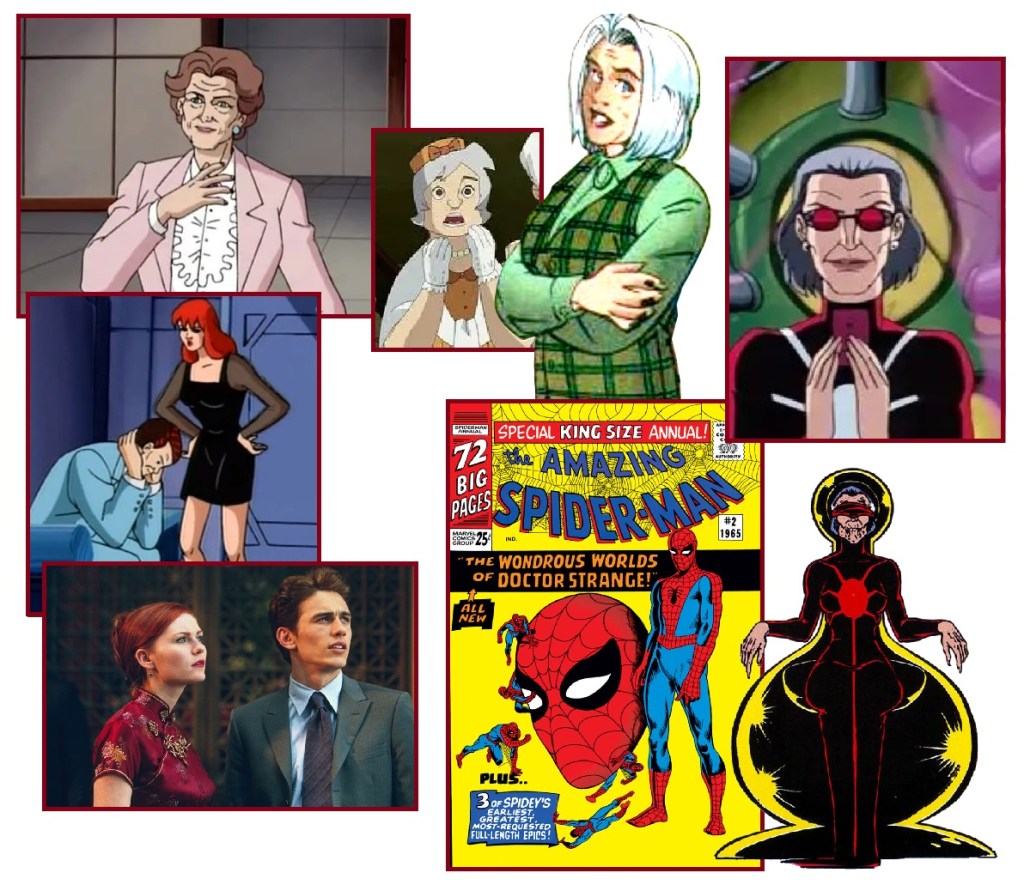
Anna Watson, Mary Jane’s interfering and mean aunt, is voiced by the mother of Star Trek, Majel Barrett-Roddenberry. This episode marks her first appearance on the show, despite being mentioned as far back as season one. One final connection to Trek: Wong is voiced by Sulu actor and activist George Takei.
Baron Mordo is voiced by Tony Jay, who’s been in everything from Star Trek: The Next Generation to Picket Fences. He’s known more for his voice work. He voiced Galactus in Fantastic Four. Ed Gilbert, who is the voice of Dormammu, worked with Filmation on Bravestarr, the Mandarin for Iron Man season one and was also the voice of Tigger.
John Vernon, who voices Strange, was Thunderbolt Ross on The Incredible Hulk. He was also Iron Man in the 1966 series.
Mary Jane disappeared at the end of The Final Nightmare. She will disappear again at the end of this season also. Mary Jane started dating Harry Osborn in Blade, the Vampire Hunter.
The story of the episode is softly based on Amazing Spider-Man Annual #2.
Thwip Quip: On Doctor Strange’s magic: “He sure puts Mysterio’s hocus pocus to shame.” / “He should take that act to Vegas. All he needs is a couple of tigers.” There’s also his farewell to Strange: “And may your amulets never tickle.”
Although she doesn’t speak, Madame Web makes a cameo at the end of this episode. Her arc will play out right until the series finale.
MASTER OF THE MYSTIC ARTS!
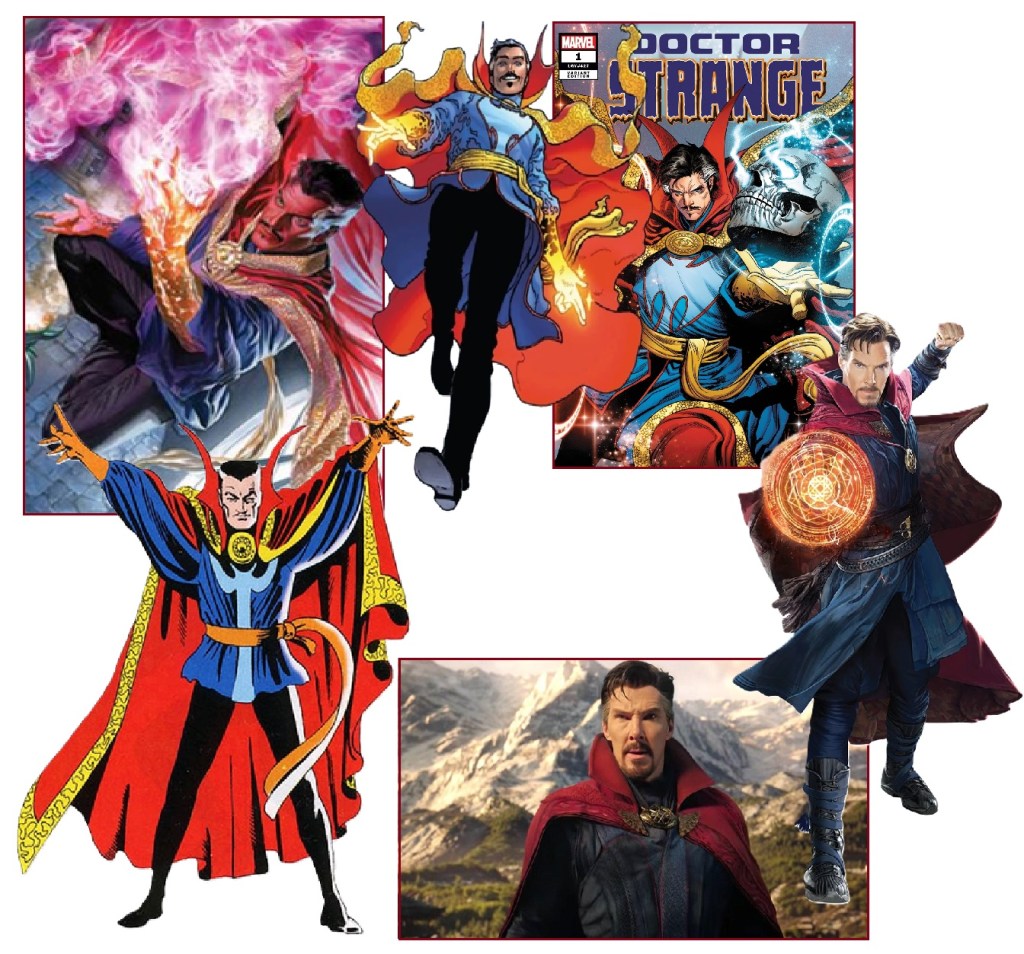
Doctor Strange first appeared in Strange Tales #110 (July 1963), created by Steve Ditko and Stan Lee. Introduced as a mysterious figure in Marvel’s anthology series, Stephen Vincent Strange was once a brilliant but arrogant surgeon whose career ended after a car accident shattered his hands. Desperate to restore his skills, he sought out the Ancient One in Tibet, where he was humbled, trained, and ultimately transformed into the Sorcerer Supreme — protector of Earth against mystical and interdimensional threats.
In the comics, Strange’s stories often explore themes of redemption, responsibility, and the balance between science and mysticism. He has battled foes like Baron Mordo, Nightmare, and Dormammu, while also serving as a founding member of the Defenders and later joining the Avengers and the Illuminati. His arsenal includes relics such as the Eye of Agamotto and the Cloak of Levitation, and his mastery of spells makes him one of Marvel’s most powerful heroes.
Doctor Strange has appeared widely outside the comics. He was featured in the 1978 television movie Dr. Strange, voiced in multiple animated series including Spider-Man and The Super Hero Squad Show, and starred in Marvel Studios’ Doctor Strange (2016), portrayed by Benedict Cumberbatch. This cinematic version reintroduced him to mainstream audiences, with appearances in Avengers: Infinity War, Avengers: Endgame, and Doctor Strange in the Multiverse of Madness (2022).
Strange endures because he embodies the collision of rational science and mystical wonder. His journey from arrogance to humility, from surgeon to sorcerer, makes him a hero defined not by physical strength but by wisdom, discipline, and the willingness to confront forces beyond comprehension.




 X-Cess Minutiae
Leave a comment