


THE SINS OF THE FATHER
Chapter II
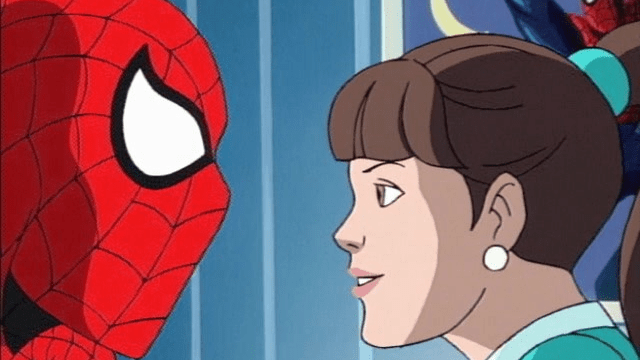
Children love heroes. From police officers and fire responders to paramedics and doctors, they look to those who save lives. In the world of superheroes, that devotion is magnified — no figure inspires more awe than the costumed champion who defies danger. Make A Wish, drawn in part from Amazing Spider-Man #55–56, explores this bond through Taina, a young girl who idolises Spider-Man much as Timmy Harrison did in Amazing Spider-Man #248, when Peter revealed his origins to a dying child.
The theme is devotion and danger. While re-reading John Byrne’s Fantastic Four #285, one recalls Tommy Hanson, a boy who worshipped the Human Torch. Like Timmy, he collected clippings, drew pictures, and lived vicariously through his hero. Yet tragedy struck when Tommy tried to emulate Johnny Storm, suffering fatal burns. Johnny’s grief drove him to renounce his identity, until the Beyonder reminded him that Tommy’s life had been enriched by his hero’s exploits. It was a sombre lesson: admiration can inspire, but it can also imperil.
This episode carries that same sentiment. Taina’s adoration of Spider-Man is innocent, pure, and deeply moving. She embodies the child’s perspective — seeing in her hero not the burdened man beneath the mask, but the symbol of courage and hope. Yet her devotion places her in peril when Doctor Octopus enacts his latest scheme, twisting Spider-Man against her. The hero she worships becomes, for a moment, her greatest threat.
Make A Wish is about the fragile line between inspiration and danger. Children love heroes, but their world is not safe. The episode reminds us that every mask carries weight, every symbol carries risk, and that even the purest admiration can be exploited. Spider-Man’s struggle here is not only against Octopus, but against the fear that his very existence might endanger those who believe in him most.
Anastasia Hardy hosts a demonstration of Doctor Michael Pingree’s “Argon Matrix Laser”, a device of great promise. Yet the unveiling is shattered when Doctor Octopus storms the event, furious that Hardy and Pingree are attempting to claim credit for what he insists is his invention. Spider-Man intervenes, but Ock turns the laser against him — only to discover it cannot cut organic matter. In the ensuing battle, Spider-Man damages two of Ock’s tentacles, driving the fight into the medical lab. The clash ends in explosion, hurling both combatants into the water. Spider-Man drags himself ashore, while Octopus escapes by hijacking a boat.
The following day, J. Jonah Jameson seizes the opportunity to vilify Spider-Man, berating him for the destruction of the medical facility. In secret, Robbie Robertson entrusts Peter with a letter addressed to Spider-Man, written by a young admirer named Maria Taina Elizando. Yet Peter, weighed down by guilt and exhaustion, vows to abandon his life as Spider-Man. It is then that Madame Web appears, warning him that he is entering a period of training for an ultimate battle. Her first lesson is cryptic but profound: he must learn the “faith of a child”. She returns to him the discarded letter, urging him to listen.
Moved, Spider-Man visits Taina at her home. She proudly shows him her collection of photographs and memorabilia, her devotion to the hero she idolises. In return, Peter shares his origin — the bite that gave him his powers, the vow that made him a crimefighter. He confesses his guilt over Uncle Ben’s death, and his despair at the destruction caused in the recent battle. For a moment, he admits he is ready to quit. Yet Taina’s faith rekindles his spirit, and he agrees to take her on a brief web-slinging journey across the city.
Meanwhile, Doctor Octopus unveils his latest creation to the Kingpin: the Octobot, a weapon designed to destroy Spider-Man. Kingpin releases his Spider Seekers to aid the hunt, and Octopus sets out with his machine. Their timing collides with Peter’s moment of renewal. Ambushed by the Octobot, Spider-Man is swiftly overwhelmed, defeated before he can resist. Taina, caught in the chaos, narrowly escapes.
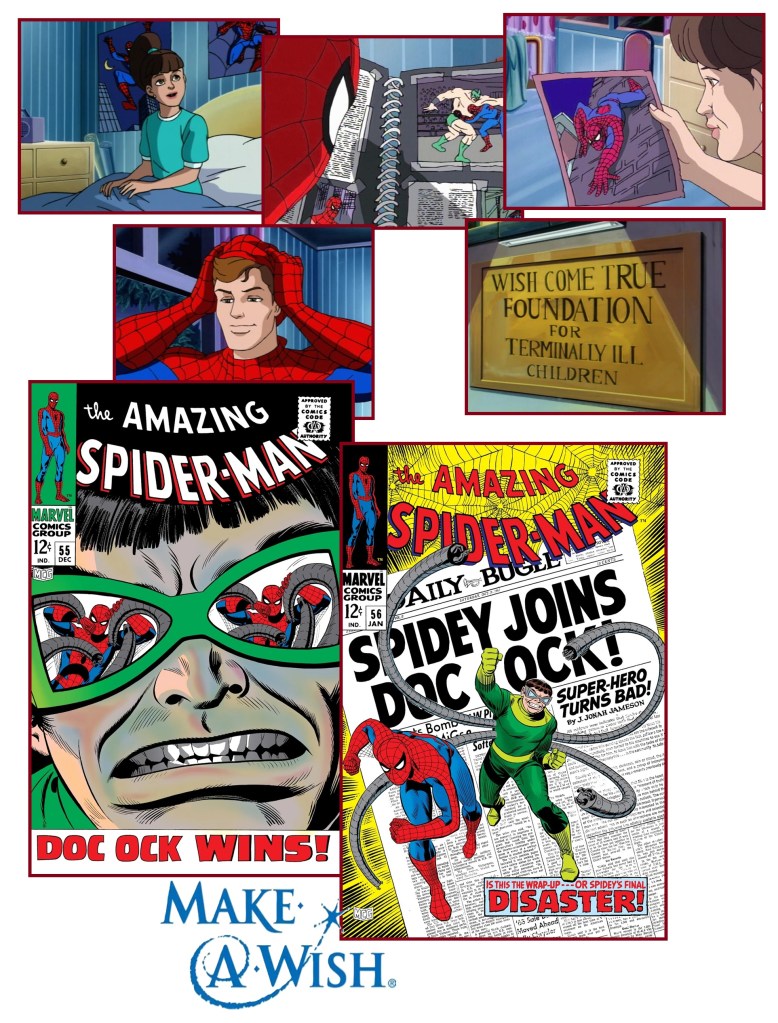
The scenes with Taina are based on the events of Amazing Spider-Man #248. See the Outbox below for more. Taina even mentions a friend, Timmy, who is the boy in the comic story. The Doctor Octopus story comes from Amazing Spider-Man #55-56 (1967).
The episode’s title is a reference to the real-life Make-A-Wish Foundation.
Stan Lee’s wife, Joan Lee, who was also the voice of the FF’s landlady Mrs. Forbes in season one of the Fantastic Four, voices Madame Web.
An extended version of Spider-Man’s origin, from Amazing Fantasy #15, is seen in this episode.
Thwip Quip: “The only thing I’m embarking on is a trip outta here.”
Jonah’s Jibes: “Spider-Man’s a glory hog who never thinks of the consequences of what he’s doing!”
AMAZING SPIDER-MAN #248:
“THE KID WHO COLLECTS SPIDER-MAN!”
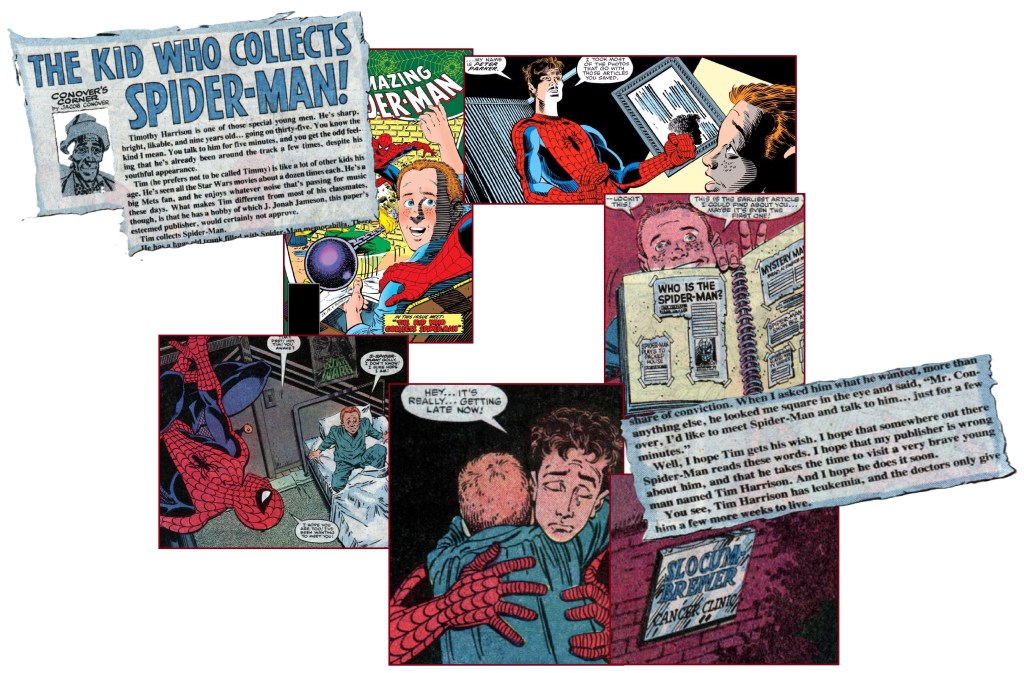
The Kid Who Collects Spider-Man! is not a tale of battle or spectacle, but of connection. In Timmy Harrison, a young boy who idolises Spider-Man, the story distils the essence of heroism into its most human form. Timmy’s room is filled with clippings, memorabilia, and devotion — a shrine to the hero who inspires him. Yet what matters most is not the collection, but the encounter: Spider-Man himself stepping into that room, unmasking, and sharing his story with a child who believes in him utterly.
The theme is mortality. Timmy is dying of leukaemia, and the issue confronts this truth with quiet dignity. Spider-Man’s decision to reveal his identity is not about spectacle, but about gift — giving Timmy something no one else has, a moment of truth and trust before the end. It is a reminder that heroism is not only measured in battles won, but in compassion offered, in the willingness to share vulnerability with those who need it most.
The sentiment is bittersweet. For Timmy, the visit is joy, validation, and fulfilment. For Spider-Man, it is sorrow tempered by grace. He cannot save Timmy, cannot fight this battle with webs or strength, but he can give him meaning, recognition, and the comfort of knowing that his hero is human too. In that exchange, the mask becomes not a barrier but a bridge.
The Kid Who Collects Spider-Man! endures because it strips away the noise of superheroics and reveals the heart of the character. Spider-Man is not simply a figure of action, but of empathy. The story teaches that sometimes the greatest victories are not against villains, but against despair — and that the true power of a hero lies in the ability to inspire, to comfort, and to connect.





 X-Cess Minutiae
Leave a comment