


THE SINS OF THE FATHER
Chapter III
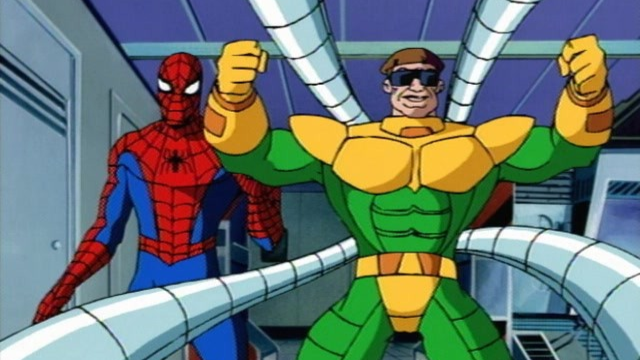
Attack of the Octobot continues the arc begun in Make A Wish, but shifts its focus from Spider-Man’s guilt to the bonds that sustain him. The episode is not only about the clash with Doctor Octopus, but about the hidden networks of care and camaraderie that exist beneath the city — ordinary people stepping forward when a hero falters.
The theme is helping others. Mousie, the cab driver, and her fellow drivers embody the unseen underside of Manhattan: a community of workers who know the streets, who look out for one another, and who extend that solidarity to Spider-Man and Taina. Their intervention is not born of power or destiny, but of friendship and compassion. In their alliance, the series reminds us that heroism is not confined to masks and powers; it thrives in ordinary acts of loyalty and courage.
At the heart of the story is Taina, the child who idolises Spider-Man. Her faith in him is unshaken even when Octopus turns him against her. She becomes the moral compass of the episode, reminding Peter of who he is when memory and identity are stripped away. The friendship between Spider-Man and Taina is tender, fragile, and deeply human — a bond that transcends the battles of villains and machines.
The episode’s bravery lies in its ending. After Spider-Man restores his identity and takes Taina home, he leaves without noticing the sign outside: a home for terminally ill children. The revelation that Taina herself is dying reframes everything we have seen. Her devotion, her courage, her insistence on believing in Spider-Man — all of it comes from a child who knows her time is short. It is a twist that is not only bold for an animated series, but profound as fiction.
Attack of the Octobot is about friendship and faith, about the strength found in helping others, and about the courage of a child who believes in heroes even as her own life fades. It is a reminder that Spider-Man’s greatest battles are not only against villains, but against despair — and that sometimes, the truest heroism lies in the quiet resilience of those who inspire him.
Having defeated Spider-Man with his Octobot, Doctor Octopus renders him unconscious with knockout gas and drags him back to his lair. Unseen, Taina slips into the boot of Ock’s car, determined to follow. At the hideout, Octopus employs the Neuro Neutraliser, erasing Spider-Man’s memories and twisting his mind into believing they are partners in crime. Witnessing this corruption, Taina escapes, desperate to find help. Alone on the streets, she is taken to the police station, where she meets Mousie, a cab driver whose compassion drives her to intervene.
Mousie and Taina shadow Octopus and his captive, following them to the Wellington Foundry. There, Ock distracts the guards while the brainwashed Spider-Man steals a rare alloy. Taina, unable to stand by, enters the building and triggers the alarm. Despite the chaos, Spider-Man and Ock escape with the prize, leaving Taina and Mousie to seek allies.
Their plea to J. Jonah Jameson falls on deaf ears. Jonah seizes the chance to vilify Spider-Man, broadcasting that he has joined forces with Octopus. Undeterred, Mousie rallies her fellow cab drivers, forming a street-level resistance to track the villains. Their pursuit leads them to another heist, where Octopus seizes the Argon Matrix Laser. Mousie is captured, taken to Ock’s hideout, and bravely attempts to restore Spider-Man’s memory.
At the brink of Mousie’s destruction, the cab drivers crash through the building, joined by Taina. The shock and defiance rekindle Spider-Man’s true self. His memories restored, he turns on Octopus, defeating him and ensuring his arrest. The alliance of ordinary citizens — cab drivers and a child — proves decisive, their faith and courage breaking the villain’s hold.
In the aftermath, Spider-Man escorts Taina home. In a gesture of trust and gratitude, he unmasks, revealing his true identity. For Taina, the hero she adored is no longer a distant figure, but a man — flawed, burdened, yet resolute. For Spider-Man, it is a moment of connection, a reminder that even in the darkest battles, the faith of a child can restore the strength of a hero.
He bids the girl farewell, swinging from the window, perhaps not noticing the sign in the building wall. It’s a home for terminally-ill children.
Thwip Quip: “Face it, Ock. These kids today just have no respect for their elders.”
MADAME WEB: PSYCHIC COUNSEL

Cassandra Webb, the original Madame Web, enters the animated series as more than a mystic seer — she becomes the architect of Spider-Man’s destiny. In the comics, Madame Web was introduced in The Amazing Spider-Man #210 as a clairvoyant bound to a life-support chair, her powers rooted in precognition and telepathy. Yet in the animated adaptation, her role expands dramatically, aligning her with cosmic forces far beyond her comic origins.
This series makes her the Beyonder’s assistant during Secret Wars, a striking creative choice. Rather than a passive oracle, she becomes an active participant in shaping Spider-Man’s trials, guiding him through battles that test not only his strength but his spirit. This transformation elevates her from a supporting mystic to a central figure in the mythos, embodying the theme of mentorship: the hero must be trained, tested, and prepared for challenges greater than himself.
Madame Web was voiced by Joan Lee, wife of Stan Lee. While some may speculate that her casting was influenced by that connection, the performance itself stands on its own. Joan’s voice carried gravitas, warmth, and an enigmatic authority that perfectly suited Cassandra Webb. Her delivery imbued the character with both mystery and maternal strength, ensuring Madame Web’s presence lingered long after each scene.
From her introduction onward, Madame Web recurs throughout the series, guiding Spider-Man until the final episode. She is the thread that ties together his journey, reminding him that his battles are not only against villains but against doubt, fear, and the limits of his own belief. As the Beyonder’s assistant, she embodies the bridge between mortal heroism and cosmic destiny, ensuring that Spider-Man’s path is never walked alone.





 X-Cess Minutiae
Leave a comment