


SIX FORGOTTEN WARRIORS
Chapter III
With the voice of the late Paul Winfield lending gravitas to Omar Mosely, this chapter stands apart from the rest of the saga. It is steeped in legacy, history, and the weight of forgotten heroes. The series pauses its espionage intrigue to flash out the story of the Six American Warriors, anchoring Spider-Man’s Russian adventure in the mythic roots of Marvel’s wartime past.
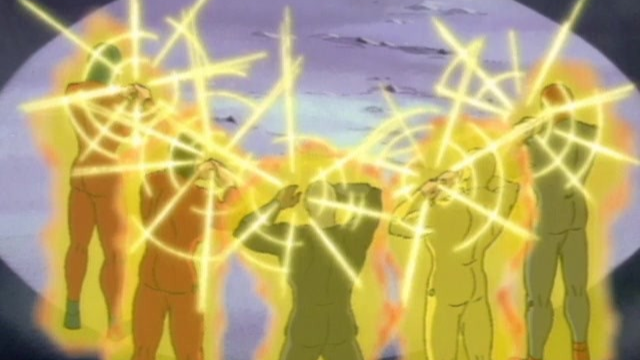
We revisit Captain America’s beginnings, first glimpsed in season four, but here given greater import and detail. Alongside him, five volunteers stepped forward to join the crusade: the Black Marvel, the Thunderer, Miss America, the Whizzer, and the Destroyer. Their powers, bound to rings rather than serum, made them imperfect echoes of Cap — yet their courage was no less real. This episode restores them to memory, elevating figures who had long been overlooked outside of Timely Comics’ oldest pages.
Thematically, Chapter III is about resurrection and recognition. These heroes are effigies from Marvel’s past, resurrected in the present day, much like Captain America himself. They are reminders of an era when Marvel was still an idea waiting to dazzle, when characters were experiments in myth and symbol. By bringing them into Spider-Man’s world, the series bridges generations of storytelling, showing that even forgotten warriors can still matter, still inspire, and still fight.
Secrets of the Six is a breath of fresh air — a celebration of early comic book imagination, reframed through the lens of Spider-Man’s modern saga. It is both homage and expansion, a reminder that history is never truly lost, only waiting to be remembered.
Now back in America, Peter is delighted to tell Aunt May that his parents were not spies at all, but loyal to their country. However, while that comes with relief, the mystery continues to deepen.
Taken to an old friend of Robbie‘s, Omar Mosely, Peter and Robertson are stunned when he unveils that not only was he a sidekick to the Black Marvel but also has custody of Captain America‘s shield!
Revealing the truth, he tells of five more super-soldiers created during the war, based on what was remembered of the Super-Soldier formula. While the five volunteers received various powers, they faded as the serum was unstable. However, they came when called and eventually disbanded and faded into obscurity.
In a final battle with the Red Skull, he and Captain America were lost in a time vortex and, without their leader, they sealed their base and went their seperate ways, each with keys to the base and the location of the Doomsday Machine.
Kingpin has also analysed the keys however, and sends the Insidious Six out to find them. In short order, Bob Frank is attacked by the Rhino; Madeline Joyce is trapped by the Vulture. The Scorpion attacks Marlow at the Parker house – and he reveals himself as the Destroyer. Defeating the Scorpion, they must now work together to find the other keys before the Kingpin does.
ROGUE’S GALLERY
RED SKULL
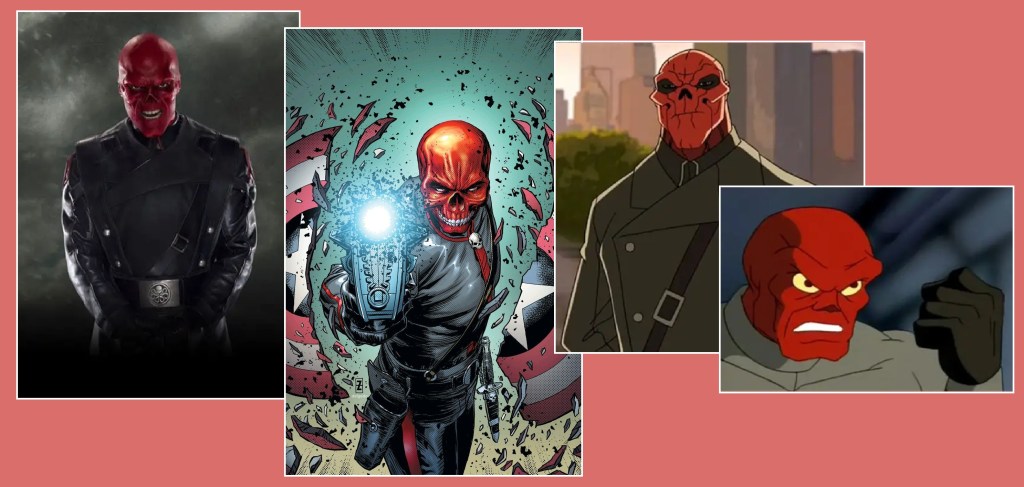
The Red Skull first appeared in Captain America Comics #1 in 1941, created as the embodiment of Nazi terror. Johann Schmidt was a man twisted by ideology, his crimson mask reflecting the hatred and cruelty beneath. He became Captain America’s perfect opposite, a villain defined not just by power but by the corruption of belief.
Over the years, the Skull endured beyond the war, surviving through cloning, stolen bodies and sheer will. He adapted to new eras while never losing the essence of his original evil, a reminder that tyranny and hate do not vanish with time. His reach extended far beyond Cap’s battles, touching Spider-Man’s life when he orchestrated the deaths of Richard and Mary Parker, leaving Peter orphaned and shaping the path that would define him.
The Red Skull’s impact on Marvel is lasting. He is not simply a man in a mask, but a symbol of corruption and the persistence of evil across generations. In Spider-Man’s mythos, he remains a hidden architect of tragedy, proof that even the most personal losses can be traced back to forces larger than ourselves.

Mosley refers to the scientist leading the Super Soldier Program as Professor Reinstein, the name used in Captain America Comics #1 (1941). In a 1975 comic, it was revealed that Reinstein’s real name is Abraham Erskine, which is also the name used in the MCU, where he’s portrayed by Stanley Tucci.
HEROES OF THE WAR

The Six Forgotten Warriors arc in Spider-Man reached back into Marvel’s earliest days, resurrecting figures from Timely Comics who had long since faded from memory. Ms America, the Whizzer, the Thunderer, the Black Marvel and the Destroyer were wartime heroes, born in the 1940s when comics themselves were young and the world was at war. They were created as patriotic champions, fighting spies and saboteurs, embodying the spirit of their age. By the 1990s, they were relics, remembered only by the most devoted readers, until the animated series gave them a second life.
Their return was not played for nostalgia alone. In the story, these heroes were shown as aged veterans, still carrying the weight of their battles, still defined by the choices they had made decades earlier. They were flawed, weary, and in some cases bitter, but they remained symbols of a time when heroism was simpler, when the fight was clear and the enemy obvious. Spider-Man’s encounter with them became a bridge between eras, linking his modern struggles to the legacy of those who came before.
The impact of their inclusion was quietly profound. For younger viewers, they were curiosities, strange names and costumes from a forgotten past. For older fans, they were a reminder of Marvel’s roots, of the pulp and patriotism that gave birth to the superhero genre. In the arc, they stood as echoes of history, warriors who had been left behind by time but who still mattered, still carried the myth of heroism in their bones. Their presence gave the series a depth beyond its usual scope, a nod to the idea that every hero, no matter how obscure, has a place in the tapestry of Marvel’s story.




 X-Cess Minutiae
Leave a comment