


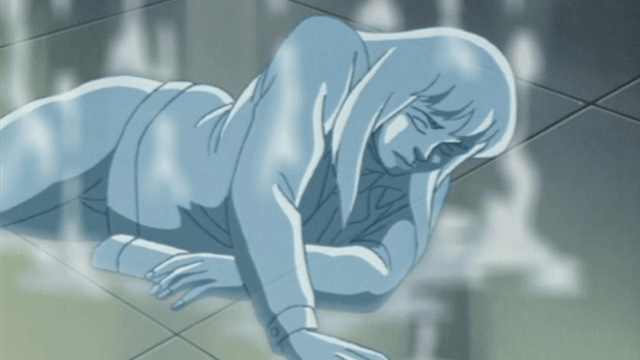
The shocking cliffhanger of Mary Jane’s water‑based powers is carried forward here, as Spider-Man discovers that her transformation is no accident. Pursuing Hydro-Man to an underwater laboratory, Peter uncovers the work of scientist Miles Warren — a figure steeped in controversy, whose obsession with cloning has led him down a dangerous path. Warren has created a duplicate of Hydro-Man, and even more disturbingly, used a single drop of his essence to fashion a clone of Mary Jane herself.
The revelation is devastating. Both clones are unstable, their bodies unable to sustain the borrowed power, and they perish before Peter’s eyes. In a moment of quiet grief, Spider-Man says goodbye to the Mary Jane clone, mourning not only her loss but the violation of his love’s identity. The episode pivots from action to tragedy, underscoring the fragility of life and the dangers of tampering with it.
Yet Warren’s schemes are far from over. After Spider-Man departs, he contacts Alistair Smythe, arranging for Silvermane’s men to repair his laboratory. In a chilling tease, Warren is shown to possess a sample of Spider-Man’s costume — a hint that his experiments may soon extend to Peter himself.
The episode closes on a bridge, where Spider-Man mourns Mary Jane, his grief heavy and unresolved. It is here that Madame Web appears, enigmatic and commanding, declaring that the time has come for Peter to fulfill his greater destiny. In exchange, she promises to guide him to Mary Jane. The stage is set for a saga that will test Spider-Man not only as a hero, but as a man caught between love, science, and fate.
Mary Jane’s sudden water‑based powers shock both her and Peter, echoing the abilities of Hydro‑Man. Determined to uncover the truth, Spider‑Man tracks Hydro‑Man to a secret underwater laboratory. Inside, he discovers that scientist Miles Warren has been conducting cloning experiments under the orders of an unnamed benefactor. Warren reveals that he has created a duplicate of Hydro‑Man, and even more disturbingly, used a single drop of Hydro‑Man’s essence to create a clone of Mary Jane.
Spider‑Man is horrified to learn that both clones are unstable. Their bodies begin to break down, and they perish before his eyes. Forced to say goodbye to the Mary Jane clone, Peter leaves the lab in grief. Meanwhile, Warren contacts Alistair Smythe, arranging for Silvermane’s men to repair the laboratory, and is shown to possess a sample of Spider‑Man’s costume — hinting at further experiments to come.
On a bridge, Spider‑Man mourns Mary Jane, his loss heavy and unresolved. It is here that Madame Web appears, declaring that the time has come for Peter to fulfil his greater destiny. In exchange, she promises to guide him to Mary Jane, setting the stage for his greatest challenge…
ROGUE’S GALLERY
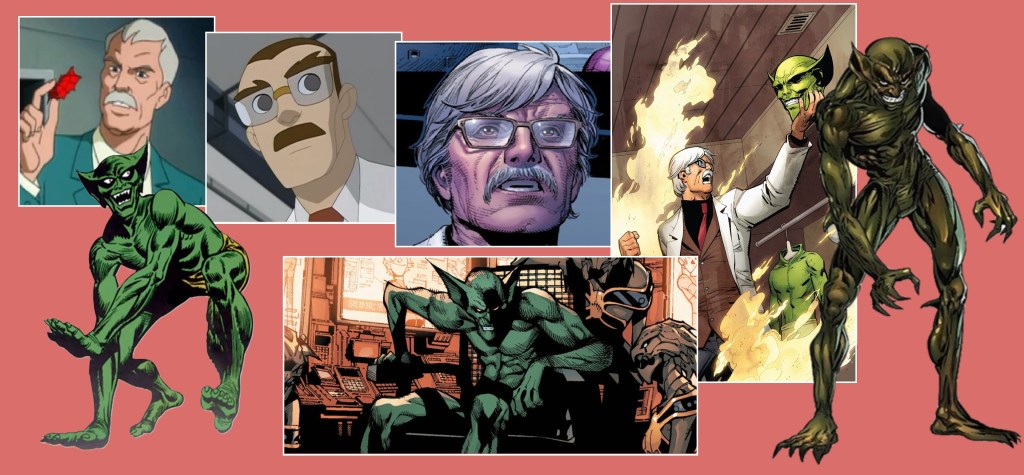
DR. MILES WARREN
Dr. Miles Warren entered Spider-Man’s mythos as a man of science, first appearing in Amazing Spider-Man #31 in 1965. A professor of biology at Empire State University, he was initially a mentor figure, teaching Peter Parker and Gwen Stacy. But Warren’s fascination with Gwen grew into obsession, and when she was killed by the Green Goblin, that grief twisted him into something darker. From that moment, the kindly professor was gone, replaced by a man consumed by loss and warped by his own desires.
It was Warren who became the Jackal, a villain defined not by brute force but by science gone astray. His experiments in cloning led to one of the most controversial arcs in Spider-Man’s history, the creation of Gwen’s clone and later Ben Reilly, the Scarlet Spider. Through Warren, the mythos explored the fragility of identity and the horror of obsession — a man who could not let go, who sought to remake the past through science, no matter the cost.
The impact of Miles Warren lies in that obsession. He is not a villain of grand schemes or world domination, but of personal tragedy, a reminder that grief can curdle into monstrosity. In Spider-Man’s story, he stands as a cautionary figure: the teacher who became the Jackal, the scientist who tried to rewrite fate, and the man whose inability to accept loss created echoes that still reverberate through the mythos.
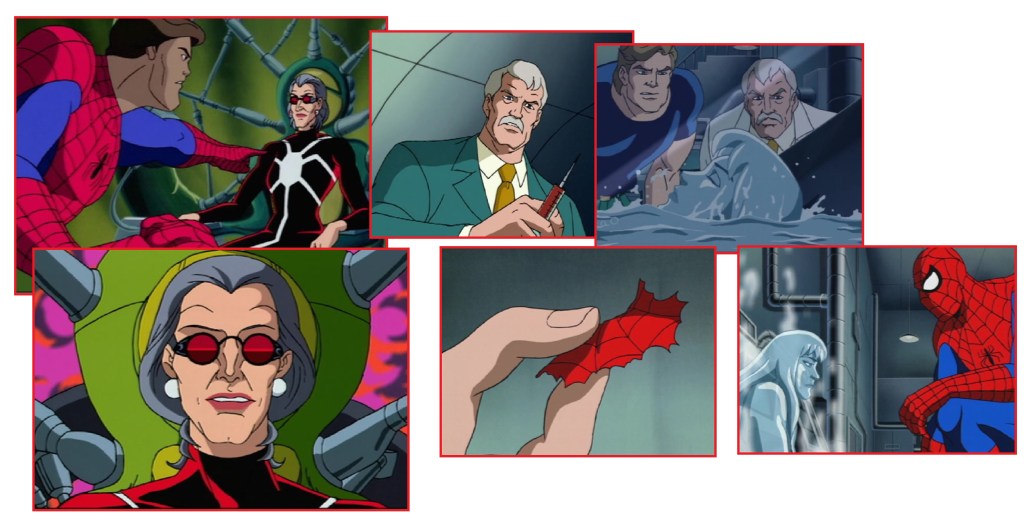
Madame Web returns, having been banished by Spider-Man in Turning Point.
The Miles Warren story may have been a plotline intended for season six, given the soaring Clone Saga in publication at the time. The Clone Saga is briefly seen in Ben Reilly’s reality in I Really, Really Hate Clones.
THE CLONE SAGA
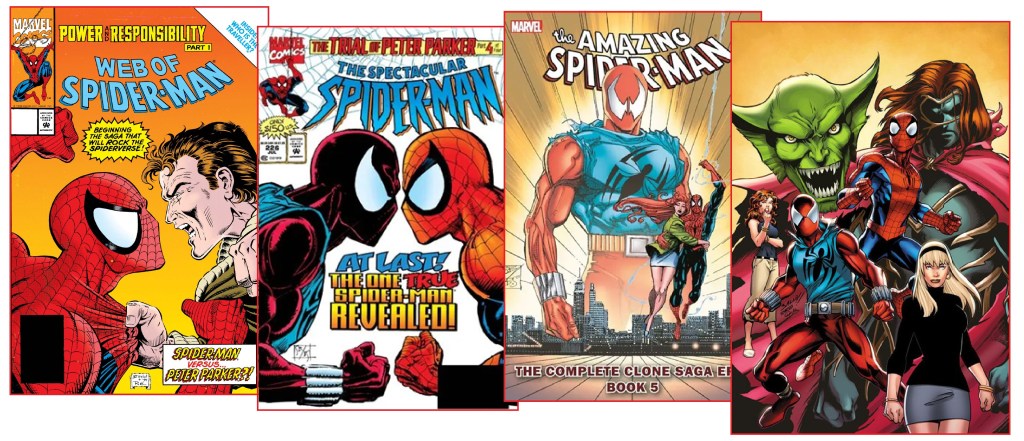
The Clone Saga began with Marvel revisiting the original 1970s tale in which the Jackal, Miles Warren, created a clone of Peter Parker after Gwen Stacy’s death. That story ended with the clone seemingly destroyed, but in the 1990s Marvel chose to resurrect the idea. The inspiration was simple yet daring: what if the clone had survived, and what if Peter Parker was not the “real” Spider-Man at all? This premise allowed writers to explore themes of identity, legacy, and the fragility of self, while also tapping into nostalgia for long-time readers.
The major plot point revolved around the reappearance of the clone, now living under the name Ben Reilly. Ben returned to New York, donning the mantle of the Scarlet Spider, and his presence threw Peter’s life into chaos. The saga questioned whether Peter or Ben was the original, and whether the life Peter had built — his marriage, his responsibilities — might belong to someone else. This uncertainty drove the story across multiple titles, with the Jackal manipulating events and cloning further characters, including Gwen Stacy, to deepen the torment.
What began as a planned year-long arc was extended into a two-year publishing event due to strong sales. Editorial decisions prolonged the story, adding layers of complexity and retcons that left many readers frustrated. While the Clone Saga introduced lasting figures like Ben Reilly and reshaped Spider-Man’s mythos, it also became infamous for its convoluted delivery. Its inspiration lay in revisiting a past story, but its legacy is one of ambition stretched too far — a reminder of how Marvel’s boldest experiments can both enrich and divide the mythos.





 X-Cess Minutiae
Leave a comment