


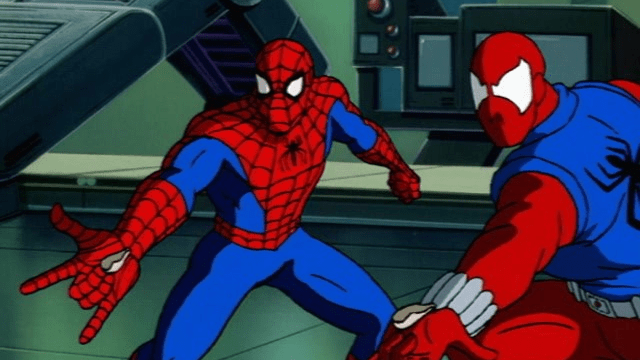

SPIDER-WARS
Chapter I
This episode explodes the series into full multiversal storytelling, years before the phrase “Spider‑Verse” became a household name. Spider‑Man is no longer alone; instead, he encounters alternate versions of himself, each reflecting a different path his life might have taken. There is the Scarlet Spider, born of cloning and brotherhood; the high‑tech Spider‑Man, armed with futuristic ingenuity; the six‑armed Spider‑Man, cursed by mutation; the tentacled Spider‑Man, echoing his greatest foe; and even an actor who only plays the hero. Together, they form a fractured mirror of Peter Parker’s identity.
Thematically, the episode explores the idea of doppelgangers — how every choice, every accident, could create a different Spider‑Man. It asks what defines the hero: is it his powers, his science, his courage, or his humanity? Against them stands Spider‑Carnage, a twisted reflection of Peter consumed by the Carnage symbiote, proving that the same foundation can lead to ruin if corrupted.
At its core, this story is about leadership and unity. The primary Spider‑Man must rally these disparate versions of himself, each flawed and incomplete, into a team capable of saving the multiverse. It is a mythic test of identity and destiny, showing that Spider‑Man is not defined by circumstance but by the choices he makes — and that even across infinite worlds, the heart of the hero endures.
Spider‑Man is transported into an alternate dimension where tragedy has reshaped its native Peter Parker. In this world, Peter has bonded with the Carnage symbiote, becoming the monstrous Spider‑Carnage. With the aid of Kingpin, Alistair Smythe, the Hobgoblin, and the Green Goblin, he has devastated New York City, leaving it in ruins. J. Jonah Jameson struggles to reach any survivors, while Robbie Robertson is forced to admit that Jameson’s warnings about Spider‑Man were right all along.
The Beyonder reveals the true scale of the threat: Spider‑Carnage intends to unleash a matter‑disintegrator bomb powered by the Time‑Dilation Accelerator, a weapon capable of destroying the entire multiverse. To stop him, the Beyonder tasks the primary Spider‑Man with leading a team of Spider‑Men drawn from across dimensions.
Joining forces with Scarlet Spider — a clone and “brother” to Spider‑Carnage — as well as a high‑tech Spider‑Man, a six‑armed Spider‑Man, a Spider‑Man equipped with Doctor Octopus’ tentacles, and even an actor who plays Spider‑Man, the team launches an assault on Spider‑Carnage’s gang at Kingpin’s base. But the mission takes a dangerous turn when the six‑armed Spider‑Man mutates mid‑battle into the feral Man‑Spider, threatening the fragile alliance.
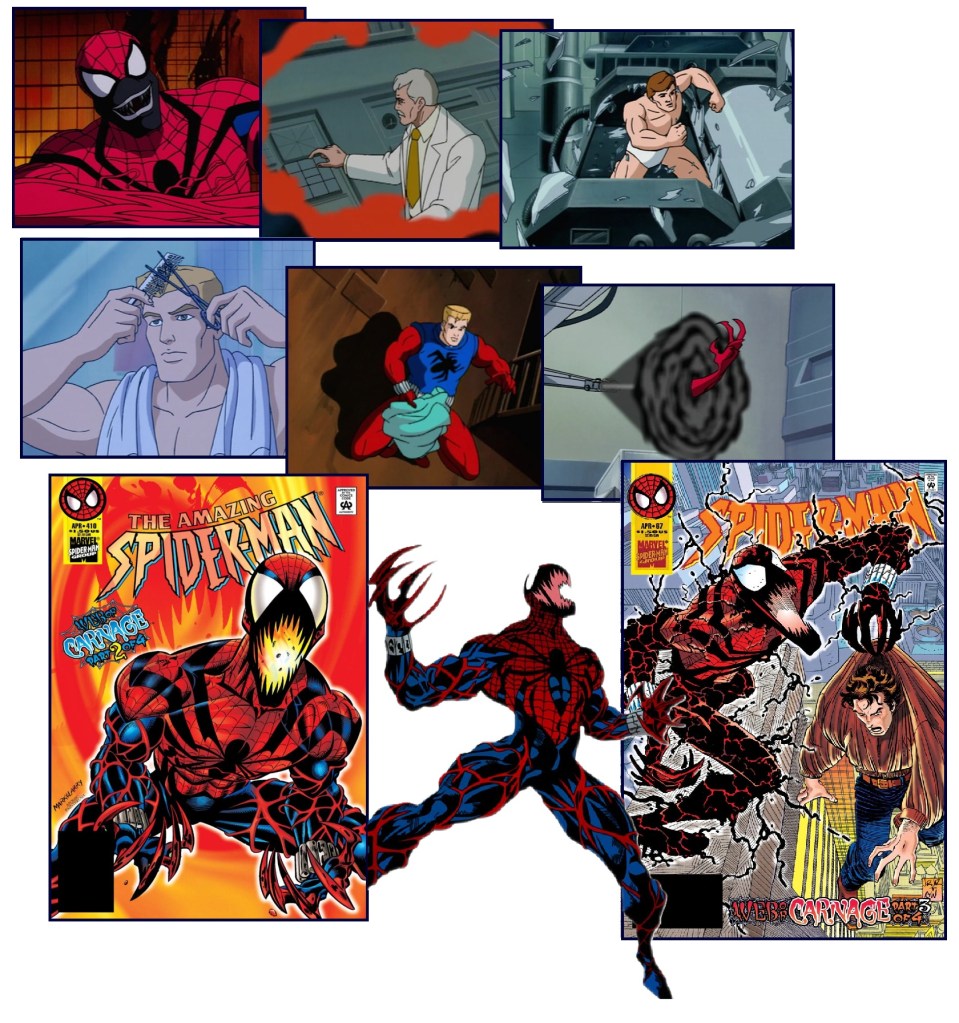
In Ben Reilly’s reality we see the effects Miles Warren may have had in our main reality had we continued the series.
Spider-Carnage debuted in Amazing Spider-Man #410, after the Carnage symbiote took control of Ben Reilly. Considering the symbiote came through a wormhole, there’s every chance that the symbiote is from Peter’s own reality.
BEN REILLY: THE SCARLET SPIDER
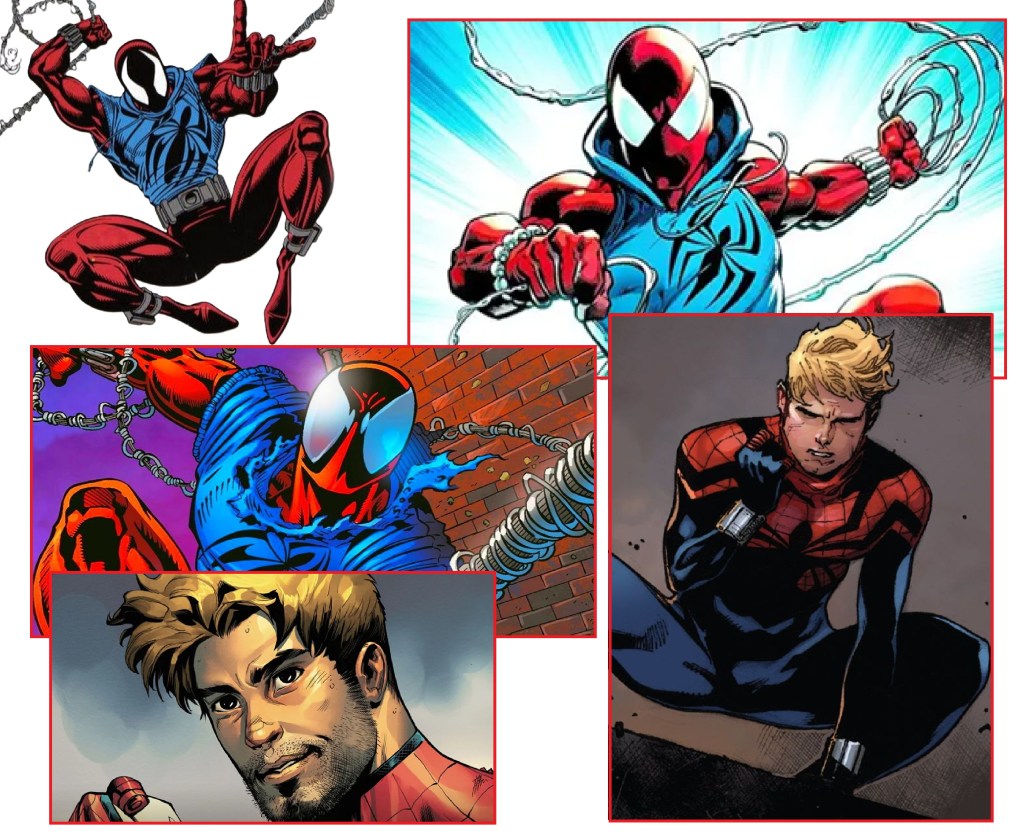
Ben Reilly was never meant to be his own man. Born of Miles Warren’s cloning experiments, he began life as a copy of Peter Parker, a shadow designed to torment the original. Yet from that artificial beginning, Ben carved out an identity that was uniquely his. He took the name “Ben” from Uncle Ben, a symbol of responsibility, and “Reilly” from Aunt May’s maiden name, grounding himself in the family he could never truly claim.
As the Scarlet Spider, Ben carried all the powers of Peter Parker — the strength, the speed, the spider‑sense — but his path was marked by doubt and improvisation. He was constantly aware that he was a duplicate, a reflection, and yet he fought to prove that he was more than a copy. His web‑shooters were modified, his tactics sharper, his style more reckless. Where Peter hesitated, Ben often leapt, driven by the need to validate his existence.
Ben’s story is one of identity and belonging. He wrestled with the question of whether he was “real,” whether his memories and emotions mattered as much as Peter’s. In the eyes of allies, he was sometimes a brother, sometimes a stranger. In the eyes of enemies, he was another Spider‑Man to be broken. But in his own heart, Ben chose to embrace the mantle of hero, even when it meant living in Peter’s shadow.
For a time, he even wore the mask of Spider‑Man itself, stepping into the role when Peter sought a normal life. Fans remember him as both a tragic figure and a cult hero — the clone who dared to believe he could be more. His legacy endures because he embodies the central truth of Spider‑Man: that heroism is not about origin, but about choice. Ben Reilly chose to fight, to protect, and to matter. And in doing so, the Scarlet Spider became real.





 X-Cess Minutiae
Leave a comment