


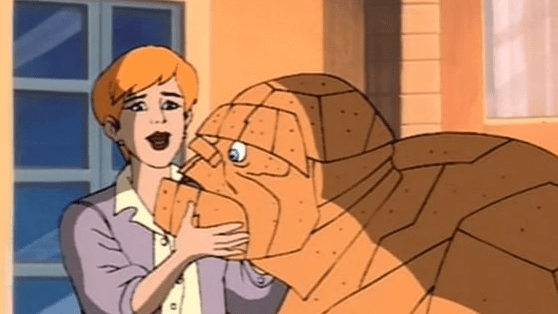

Following the momentum of its premiere, The Origin of the Fantastic Four (Part 2) shifts from cosmic spectacle to something more intimate: the question of belonging. While the team continues their televised retelling of their earliest days, the episode pivots from transformation to connection – introducing Alicia Masters, a character who, despite being caught in the Puppet Master’s twisted scheme, becomes a quiet revelation. Her immediate empathy toward the Fantastic Four – particularly Ben Grimm – offers a counterpoint to the fear and rejection they often face. She doesn’t flinch at Ben’s rocky exterior. She sees the man beneath it.
This second chapter deepens the show’s emotional core, exploring the idea that family isn’t just forged in radiation or battle – it’s found in the people who choose to stay. Alicia’s acceptance is unconditional, and in her, the team finds not just an ally, but a kindred spirit. Her presence reframes the narrative: while the Puppet Master tries to control others through clay and coercion, Alicia offers something far more powerful – trust.
Ben’s internal struggle takes centre stage here. While the others see him as a hero, he still sees himself as a monster. It’s Alicia’s quiet kindness that begins to shift that perspective, even as he wrestles with his own self-worth. In a show often defined by spectacle, this episode reminds us that the most powerful transformations aren’t always physical.
The Origin of the Fantastic Four (Part 2) may continue the team’s first battle, but it also marks the beginning of something deeper: the formation of a chosen family. And in doing so, it proves that even in a world of cosmic rays and clay puppets, the most enduring superpower is acceptance.
With the telethon still rolling and Ben Grimm still pitching their autobiography like it’s a late-night infomercial, the Fantastic Four continue their tale – picking up right where they left off: with the Puppet Master pulling strings and the Thing under his control.
Back at the Baxter Building, Alicia – disguised as Sue – returns with the entranced Ben, who promptly throws Johnny through a bookcase and storms Reed’s lab. Reed, ever the scientist, manages to snap Ben out of it with a dose of experimental goo that, for a fleeting moment, even turns him human again. But the moment doesn’t last. The Puppet Master’s grip is strong – and his ambitions are growing.
While the team regroups, the Puppet Master escalates. Using his mind-controlling clay, he sparks a full-blown prison riot, manipulating inmates and guards alike. Meanwhile, Sue – still his prisoner – manages to escape her shackles, only to be recaptured.
The team races to confront him, battling a robot drone and chasing him into the skies. Johnny saves Sue mid-air (flame on, obviously), and the team pivots to their next crisis: stopping the prison riot before it spills into the city.
Reed’s plan? Tunnel in from below. Johnny and Ben burst through the floor like it’s a superhero heist, and the team shuts down the riot with a mix of fire, fists, and flexible thinking.
But the Puppet Master isn’t done. He sneaks into Alicia’s new apartment to retrieve his “masterpiece” – a clay puppet of himself, designed to control the world. Alicia, bless her, fights back. The puppet and the Puppet Master go out the window. When the team arrives, he’s vanished.
Back at the studio, the telethon hits $5 million, Ben’s still selling books, and the Fantastic Four’s origin story wraps with a wink. Because when your life is cosmic rays, clay villains, and televised trauma? You might as well make it entertaining.
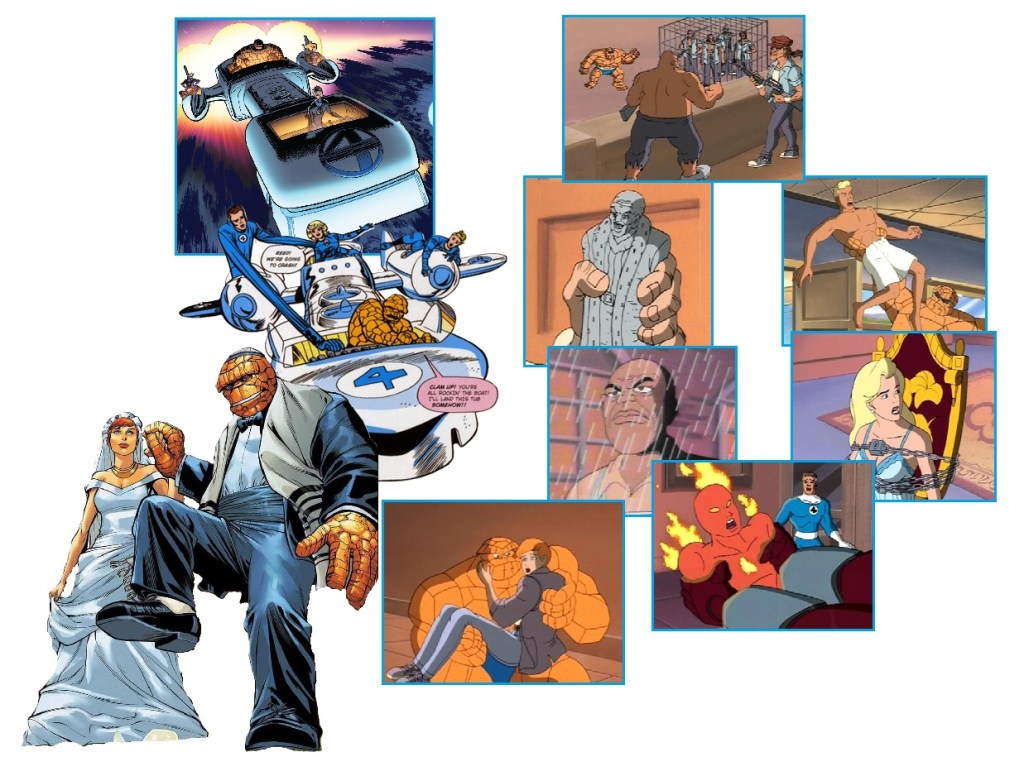
The Fantasticar makes its first appearance in this episode, modelled after the Mark II version that first appeared in Fantastic Four #12 (1962).
Due to the early nature of the series, there’s many plot holes in these two episodes, some notable ones of which take place here. The Puppet Master’s helicopter and robot come from nowhere! Johnny goes from the shower to answer the door, is attacked by Ben, flames on, destroys the towel and suddenly finds a uniform from nowhere, whilst Sue spends most of the episode tied up in a flimsy nightgown! It’s bizarre to say the least! The less said about Sue’s referring to Puppet Master as an ‘evil geek’ the better.
Unlike most Marvel shows at the time, this series doesn’t use laser guns as the other 90s shows do, such as X-Men or Spider-Man. One scene shows a prisoner blatantly pelting his targets with what appears to be a machine gun!
Ben and Alicia remain a couple throughout the series.
The animation of the finale makes it look like the original intention was for the Puppet Master to die. The last shot of the clay model implies a gnarly scene out of shot: to keep it suitable for it’s audience, Reed mentions that the Puppet Master has disappeared off-camera. The character never appears again in this series.
ALICIA MASTERS: THE FIFTH MEMBER
By all accounts, she shouldn’t have been part of the team. But Alicia Masters didn’t need powers to become family.
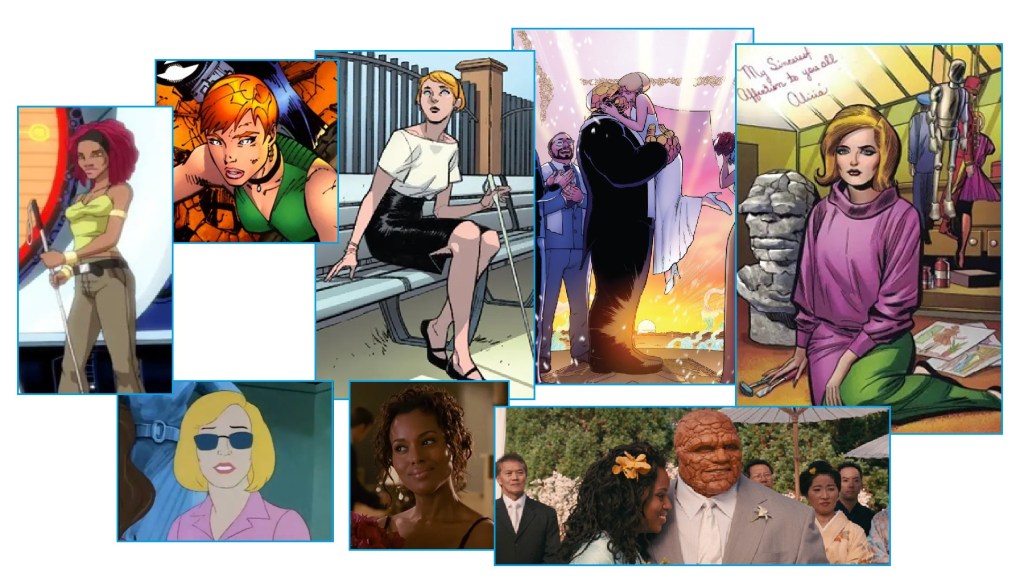
Alicia Reiss Masters first appeared in Fantastic Four #8 (1962), created by Stan Lee and Jack Kirby. Introduced as the blind stepdaughter of the Puppet Master, she was initially a pawn in one of his schemes – disguised as Sue Storm and sent to infiltrate the team. But from the moment she touched Ben Grimm’s rocky face and sensed the gentleness beneath, Alicia became something more than a supporting character. She became essential.
Her relationship with Ben – the Thing – has always been the emotional heart of the Fantastic Four. Where others saw a monster, Alicia saw a man. Her empathy, her artistry, and her unwavering belief in Ben’s humanity gave him something even Reed Richards couldn’t invent: hope.
Alicia’s importance was cemented in Fantastic Four #48–50, the legendary Coming of Galactus arc. When the Silver Surfer crash-landed in her apartment, it was Alicia – not Reed, not Sue – who convinced him to see the value of humanity. Her words helped turn the tide against Galactus. No powers. Just compassion.
Over the decades, Alicia’s role has evolved. She’s been kidnapped, replaced by a Skrull (Lyja), and even briefly romantically linked to Johnny Storm. But her bond with Ben endured. In more recent years, they finally married, and together they’ve adopted two alien children – Jo-Venn (a Kree boy) and N’Kalla (a Skrull girl) – proving once again that Alicia’s superpower is making people feel like they belong.
Outside the comics, Alicia was portrayed by Kerry Washington in Fantastic Four (2005) and its sequel Rise of the Silver Surfer (2007). Though her screen time was limited, Washington brought warmth and quiet strength to the role, echoing Alicia’s core essence.
She may not stretch, flame on, or clobber—but Alicia Masters has always been the soul of the Fantastic Four. Sculptor. Confidante. Advocate. Family.
The fifth member.
The Origin of the Fantastic Four (Part 1) | Now Comes the Sub-Mariner




 X-Cess Minutiae
Leave a comment