


Destiny Unleashed isn’t an easy episode to sit with, and it certainly isn’t the kind of story you expect from a Saturday‑morning cartoon. It’s still a jarring episode if one considers the state of the world in the late-2020s. The High Evolutionary finally reaches the end of his patience with the “inferior” culture he’s built his world upon and turns his sights toward genocide — and not abstractly, not metaphorically, but directly at the human race. It’s a chilling escalation, yet entirely in keeping with a series that has already flirted with human experimentation, body horror, and hints of cannibalism. Paired with the Kirby‑esque visual style that served Silver Surfer so well, and the sheer ambition of Counter‑Earth as a setting, this finale feels like the opening chapter of something bold and original.
But the tragedy is that it isn’t a victim of its own daring. It didn’t collapse under the weight of its ideas. It simply never got the chance to continue. Marvel Animation went bankrupt, the studio closed its doors, and several series were left stranded mid‑story. Spider‑Man Unlimited and Silver Surfer are the most painful examples — both cut off just as they were becoming something genuinely distinctive.
What makes Destiny Unleashed even more striking is how eerily prescient it feels. With its talk of genocide, mass destruction, and the weaponisation of fear, you’d be forgiven for thinking it was written in the shadow of 9/11. But it wasn’t. It aired months before those events, which only adds to the unsettling weight of its themes. The episode stands as a reminder that children’s animation, when allowed to stretch, can reach places far darker and more complex than anyone expects.
And so the season ends not with closure, but with a world on the brink and a hero powerless to stop what comes next. It’s a finale that feels less like an ending and more like a door slammed shut — not by the writers, but by circumstance.
The High Evolutionary has had enough. Reviewing months of telemetry, he declares that the Human Resistance and Spider‑Man have pushed him too far, and the violence must end. Sir Ram urges retaliation, eager for blood, while Lord Tyger hesitates — he cannot fathom punishing an entire species for the actions of a few. But the Evolutionary has already made up his mind, and his patience is gone.
Out on the streets, Spider‑Man finds Machine Men rounding up humans, dragging them from their homes and scanning them for any hint of Resistance activity. Anyone suspicious is taken away. At Naoko’s clinic, her medical licence is revoked on the grounds she’s been seen with Spider‑Man. When Peter returns, he slips into his civilian identity and distracts the robots long enough to break the tension, but the situation is spiralling fast.
The High Evolutionary broadcasts his decree: since Spider‑Man and the Resistance refuse to surrender, he will destroy human homes one by one until they do. Sir Ram revels in the destruction, while Tyger recoils. The Resistance and Spider‑Man fight back, but the Knights overwhelm them. Ram moves to kill, only for Tyger to intervene — their creator still needs Spider‑Man alive. Then the Evolutionary unleashes his new brain‑harmonic devices, knocking every human unconscious. Even Carnage and Venom, watching gleefully from afar, are soon targeted by the same weapons.
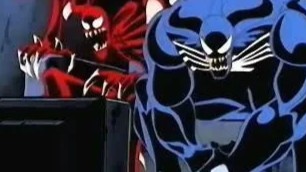
Spider‑Man wakes in a lab, imprisoned alongside the rebels — and, shockingly, alongside Eddie Brock and Cletus Kasady, now separated from their symbiotes. The Evolutionary has reached his final conclusion: humanity is too depraved, too animalistic, and must be wiped out. He activates his sonics, shaking Counter‑Earth to its core, but Spider‑Man counters with the sonic dampeners in his suit, disrupting the weapon and infuriating the Evolutionary.
A brutal battle erupts, only ending when the Goblin — alive, defiant, and very much unbroken — swoops in to help. The Evolutionary is injured, his Knights scatter, and Tyger quietly lets them flee. But the victory is hollow. Eddie reveals the truth: when he was separated from Venom, the Synoptic prepared a failsafe. If Brock and the symbiote were ever parted again, spores would launch into Counter‑Earth’s orbit, killing all non‑symbiote life. As Spider‑Man watches helplessly, the spores ignite the sky and begin to spread.
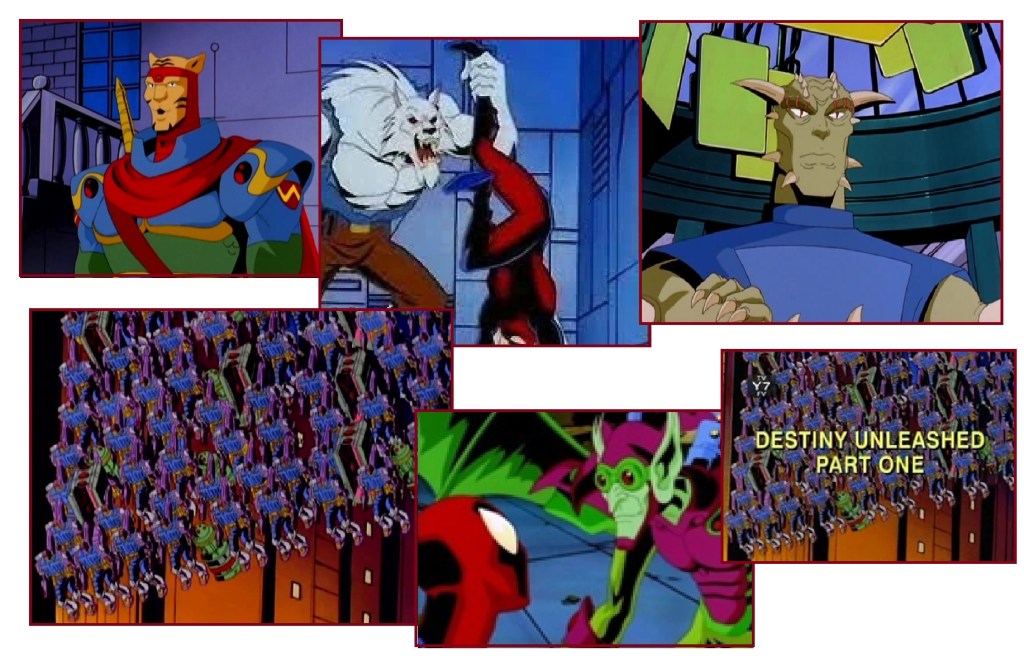
Lord Tyger, and his reputation for listening to the human’s concerns, was established in Matters of the Heart.
Spider-Man makes a joke about John Jameson becoming hairy when he’s angry, a reference to his transformations in Ill-Met by Moonlight.
Dr. Borowski may have survived his punishment from One is the Loneliest Number after all – one of the Machine Men mentions him in passing.
The Goblin reappears, alive, after the events of Sustenance. We are offered no hints to his identity.
When the episode first aired, it had ‘Part 1’ in it’s title – it was not intended as the series finale…
DESTINY UNLEASHED – PART 2?
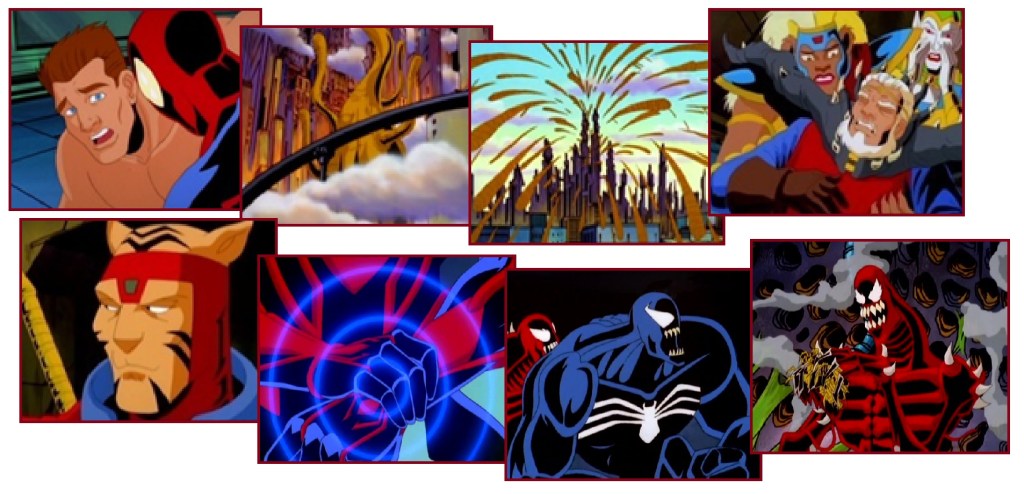
The second season of Spider‑Man Unlimited was set to push the series into darker, more serialized territory, picking up immediately from the Synoptic spores released into Counter‑Earth’s orbit. Rather than a quick resolution, the spores were intended to become the spine of the season: a slow, creeping apocalypse that would reshape the planet and force Spider‑Man into a desperate fight for survival. The writers described the Synoptic as a threat that would spread city by city, infecting the world in a way the High Evolutionary could no longer control.
Venom and Carnage were planned to return early in the season, but changed by their separation from their hosts. Eddie Brock and Cletus Kasady would have been traumatised, weakened, and forced to confront life without their symbiotes before inevitably re‑bonding in a more unstable, more dangerous form. Their arc was meant to explore identity, addiction, and the cost of being consumed by something larger than yourself. Meanwhile, the High Evolutionary — injured but alive — would retreat and unravel, shifting from authoritarian ruler to a cornered, increasingly unhinged scientist losing control of his own creations.
One of the clearest storylines mapped out was Lord Tyger’s defection. His doubts in the finale were the beginning of a full character turn: he would break from the Knights, join Spider‑Man, and become one of the season’s emotional anchors. The Goblin, revealed alive in the final moments of Season 1, was also intended to become a recurring ally — unpredictable, morally grey, and operating on motives that would only slowly be revealed. The Human Resistance, meanwhile, would fracture under pressure, splitting into factions as the Synoptic threat escalated.
Long‑term, the season was designed to move Spider‑Man closer to restoring Counter‑Earth and eventually returning home, but not before the world changed around him. His suit would evolve with new sonic and anti‑symbiote technology, the Resistance would face collapse, and the Knights would splinter as the High Evolutionary’s grip weakened. Season 2 was meant to be a story of a world in freefall — and a Spider‑Man fighting to save a planet that wasn’t even his own.


Leave a comment