


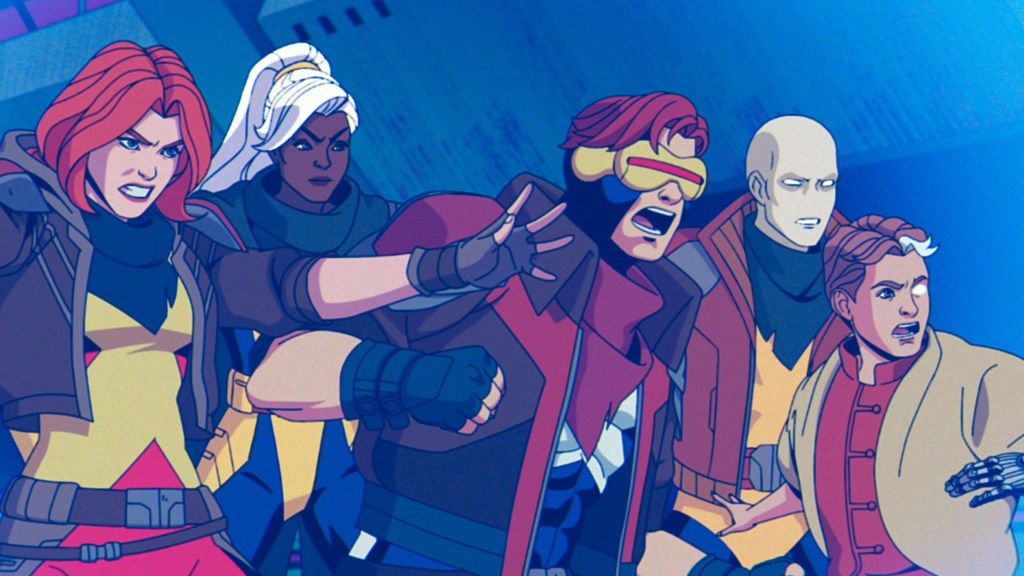
WARNING: THIS ARTICLE CONTAINS SPOILERS AND DETAILS FOR
X-MEN 97 SEASON 2

After two years of waiting, X‑Men ’97 roars back into action for its second season, and this opening chapter throws us straight into a time‑travelling epic centred on one of the X‑Men’s most enduring and dangerous foes: Apocalypse. Days of Past Future wastes no time reminding us why this series struck such a chord — the ambition is bigger, the stakes are higher, and the emotional core is already beating loudly.
The beauty of the episode is evident immediately. The animation remains a delight, with one Storm sequence in particular guaranteed to send shivers down the spine of long‑time fans. The new costumes and character designs are lifted straight from the Nineties comics, and Cable’s future has never looked better on screen. It’s a visual love letter to the era without ever feeling nostalgic for nostalgia’s sake.
There are also the little comic‑book touches that reward attentive viewers: the appearance of the Final Horsemen, Trish Tilby still bearing the scars of her transformation, and the inspired decision to scatter the team across different points in time. If future episodes explore their respective eras with the same focus this one does, we’re in for something special.
But beneath the spectacle, it’s all about family. Scott and Jean struggle with hiding their identities from Nathan, and when the truth finally comes out, he’s stronger for it. Their goodbye carries real weight — a reversal of the classic Cable tragedy, but no less affecting. And then we cut to the present, where an older Cable is assembling his own strike team, complete with welcome returns for Archangel and Psylocke. His next stop? One Jubilation Lee. To be continued indeed.
In 1997, Bishop and Forge have worked together to locate which time periods the X-Men were sent to and created a functioning time machine in order to travel there. Bishop will go into the past, to Egypt at the start of Apocalypse‘s reign, where Professor Xavier, Rogue, Nightcrawler, Beast and Magneto were deposited, while Forge will traverse to the future, where he hopes to find Storm, along with Cyclops, Jean, Wolverine and Morph, at the height of Apocalypse’s power in the 40th Century.
Forge arrives in a war zone and is immediately attacked by robot drones. He’s saved by Wolverine and Storm who are surprised to see him. He joins them in their caravan where Scott and Jean tutor the young Nathan Summers, who has no idea as to their identities. Their caregiver and guide is Mother Askani, who tells Storm that she was the one who swept the X-Men through time, in an effort to stop Apocalypse on both fronts.
Apocalypse receives word that a new vessel has been found for him: Nathan. He sends his Final Horsemen after the child, but a rescue from the X-Men sees them retreat. Scott and Jean, determined to ready Nathan, take him on a mission towards Apocalypse’s stronghold without the rest of the team and the family is captured, set on a course for Apocalypse’s citadel. Mother Askani and the X-Men follow in an old ship, repowered by Storm’s manipulation of solar winds and flares from the sun.
Imprisoned, Scott and Jean tell Nathan that they are his parents and that their powers together are truly awesome. He frees himself using telekinesis and frees his parents. The Horsemen and Ozymandias block their path, but then the X-Men arrive just in time to aid Cyclops and his family from robotic droids and the Horsemen. Apocalypse retreats, hoping to stop the X-Men in a different time when they’re more vulnerable.
Inside Apocalypse’s citadel, they discover what they came for: a ship from the stars where Apocalypse gets his ancient technology from. The X-Men have encountered the entity, known as ‘Ship‘ before. It merges with Nathan’s robotic arm.
In the Nineties, Cable has been researching Apocalypse and his past. He has assembled a new team to take the fight to the enemy, consisting of Psylocke and Archangel. When asked what their next mission is, Cable tells them they’re recruiting and shows them a file on Jubilee and Sunspot…
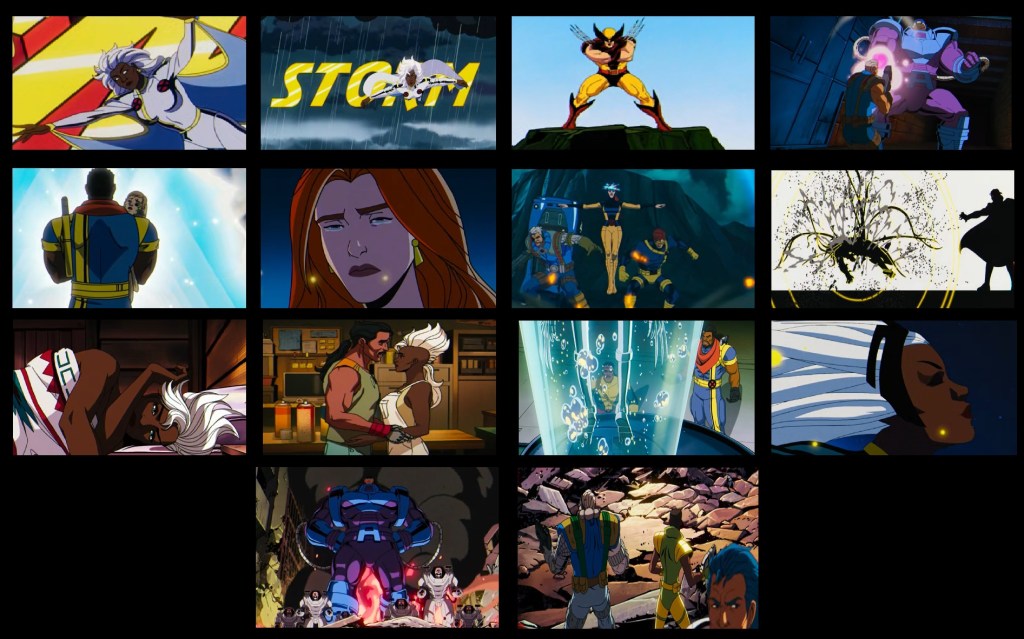
The opening titles have undergone several changes since last season. Cyclops, Jean, Storm, Wolverine and Morph appear on the titles this week, with a number of new scenes, including:
— Bishop taking Nathan away from Madelyne and into the future from Fire Made Flesh
— Cable and Apocalypse battling, from Beyond Good and Evil and Time Fugitives
— The Summers Family facing the Primes and Magneto leeching Wolverine’s bones
— Storm and Forge from Season 1’s Lifedeath
— Bishop and Forge with Wolverine’s skeleton in Days of Future Past
— Storm regaining her powers from Lifedeath
In their title cards, Storm’s hair is now long again and Wolverine is in his tan costume.
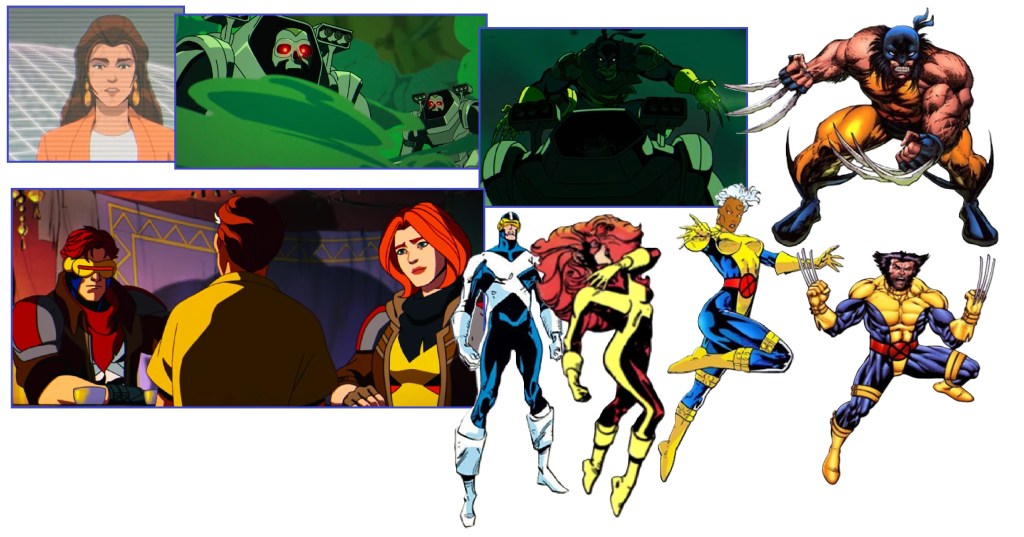
Trish Tilby presents the news. She still has scars on her face from becoming a Prime Sentinel last season.
The robots that attack Forge when he arrives in the future are the same robots Cable fought in Time Fugitives.
Wolverine’s look is from the time he lost his adamantium and went feral, circa Wolverine #100.
Storm calls Forge ‘Daniel’ for his real name, which was revealed in the season 1 finale as ‘Daniel Lone Eagle’.
Cyclops and Jean are wearing their 1980s X-Factor uniforms for the first time in the series. Storm and Wolverine are in their team outfits, circa Uncanny X-Men #273.
Although they’re not named as such, the troupe with Nathan is the Clan Askani. This history was originally seen in The Adventures of Cyclops and Phoenix [see below].
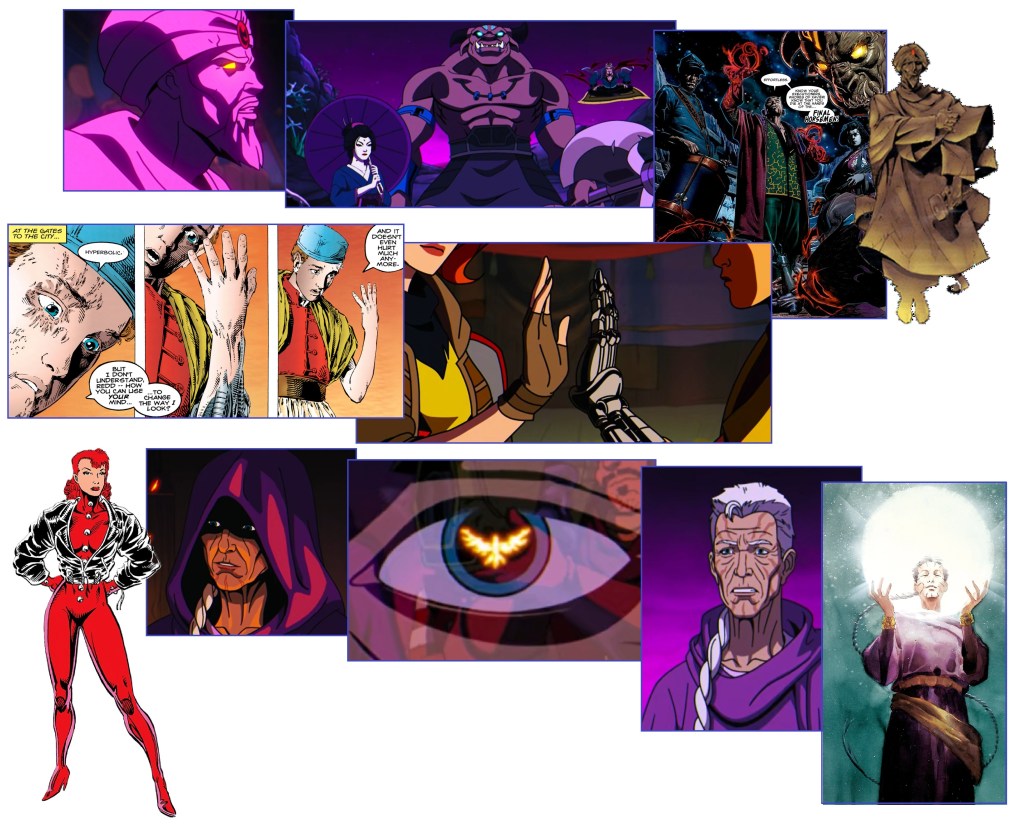
Ozymandias, first servant of Apocalypse, voiced here by Stargate veteran Tony Amendola, first appeared in Uncanny X-Men #322.
Ozymandias talks of a new vessel for Apocalypse. This process of everlasting life for Apocalypse was first mentioned in The Twelve storyline in the comics, where his target was a clone of Cable. This was also adapted for X-Men: Apocalypse, and the original series episode The Fifth Horseman, where Apocalypse claimed Fabian Cortez as his vessel.
Apocalypse’s Final Horsemen are from Uncanny X-Force #2.
The scene of Jean helping Nate hold back the Virus is duplicated from The Adventures of Cyclops and Phoenix.
Mother Askani whispers an Askani prayer from the comics. The Phoenix also appears in her eyes. When she unveils her hound marks to Storm, she reveals she is from a time much worse than this one. She’s also wearing a time band around her wrist… which is odd, since Mother Askani, aka Rachel Summers, can usually travel through time all by herself…
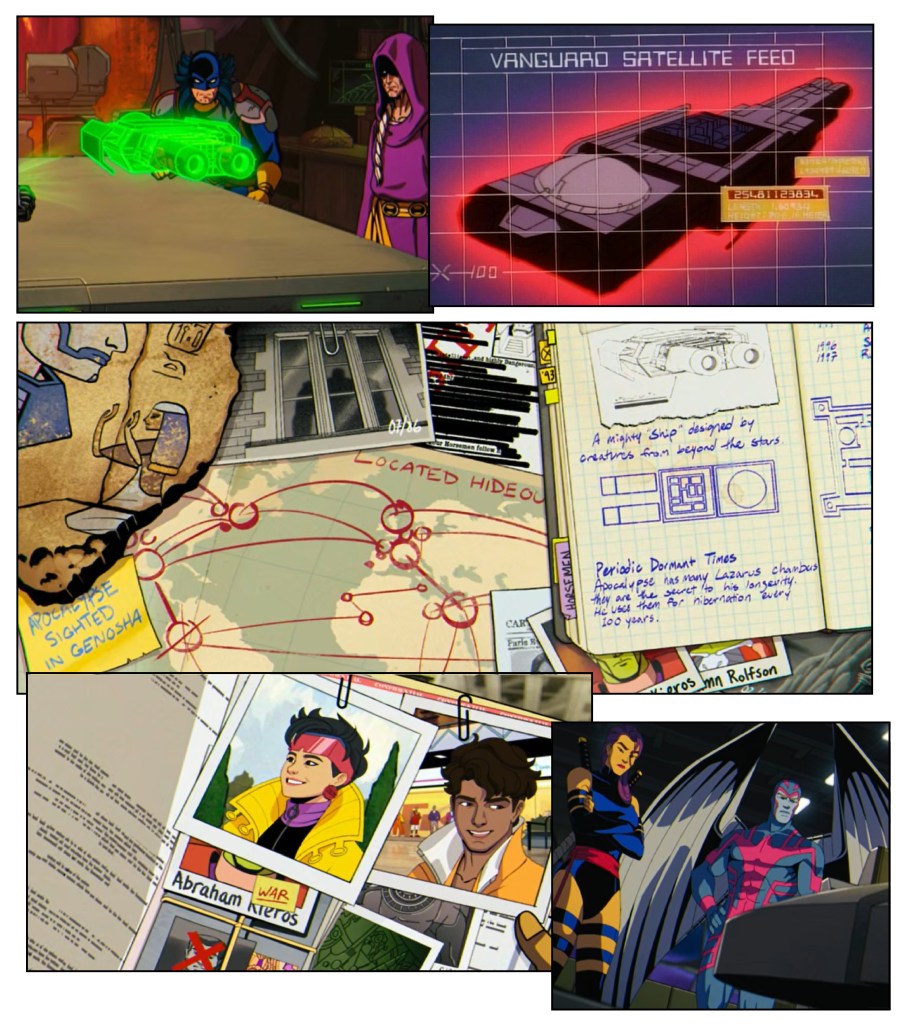
The Ship that Logan says they’re familiar with is the same Celestial Ship from Obsession.
Forge must be so annoyed with himself. His collars and their technology have survived all the way to the 40th Century!
A lovely touch – when defending his people, Nate picks up the biggest gun he can find – something adult Cable will do with regularity.
In Cable’s files, there’s a map of Ship, a photo of the Lazarus Chamber and Cortez Temple and a list of the locations Apocalypse has been seen at over the course of the animated series. It also has pictures of the Horsemen and the External Candra. It’s a nice touch of detail.
HONEYMOON IN THE FUTURE!
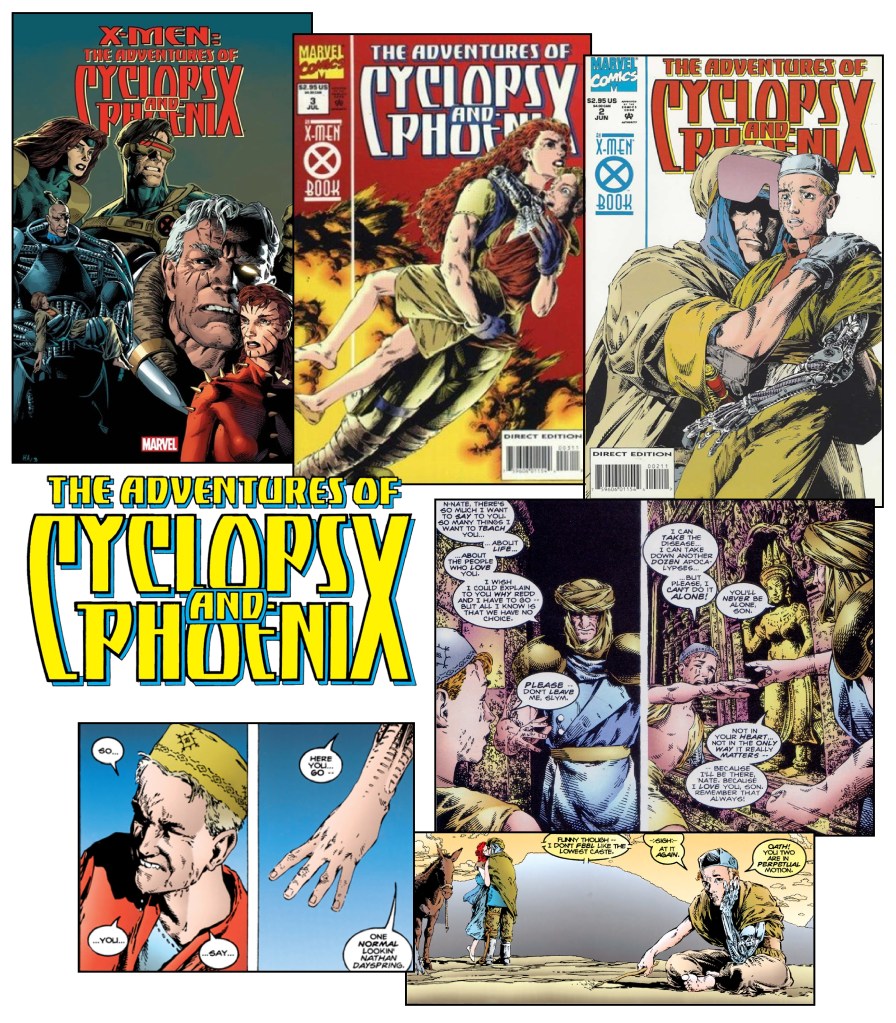
The Adventures of Cyclops and Phoenix is one of those rare X‑Men stories that reshapes the mythology without ever raising its voice. Across four issues, it takes Scott and Jean out of the chaos of the present and drops them into a future ruled by Apocalypse, not to fight a war, but to raise a child. The mini‑series reframes Cable’s origin from a tangle of time‑travel lore into something far more intimate: a family trying to give their son a life, even if that life exists centuries beyond their own.
What stands out most is how small the story feels, despite its scale. Scott and Jean aren’t leading teams or saving worlds; they’re teaching Nathan how to walk, how to trust, how to survive. The Askani future becomes a crucible for all three of them, and the mini‑series treats that time not as a detour, but as a defining chapter in the Summers legacy. It’s the first time Scott and Jean are allowed to be parents without interruption, even though they know the moment is temporary.
The tragedy, of course, is built into the premise. Their presence in the future strengthens Nathan, but it also reinforces the loop that ensures Apocalypse’s rise. The mini‑series never shies away from that paradox. It shows how love can shape a hero, even when it cannot save the timeline. Scott and Jean leave Nathan knowing they’ve given him everything they could, and knowing it still won’t be enough to stop what’s coming.
Tolerance is Extinction (Part 3) | A Force to Be Reckoned With


Leave a comment