


WARNING: THIS ARTICLE CONTAINS SPOILERS AND DETAILS FOR
X-MEN 97 SEASON 2

You cannot tell a story about Apocalypse unless you start at the beginning, which I’m told is a very good place to start. This episode finally catches us up with the X‑Men in the past, letting us witness the young man who was En Sabah Nur long before the world learned to fear his name. He’s younger than we’ve ever seen him, but already shaped by slavery, cruelty and ignorance — a life defined by survival long before the blue lips and the destiny arrive.
Magneto spends the episode speaking to Nur, which is amusing in its own way; given his history, he’s hardly the ideal candidate to guide a future tyrant toward moral clarity. But he tries, even as Charles warns him that they cannot interfere with history. It raises an uncomfortable question: why did Mother Askani send these X‑Men here if they’re not meant to change anything? Apocalypse has to rise for their present to exist, so what exactly is their role?
Perhaps the answer is that they were always here, on the periphery, powerless to stop what was already in motion. Nur’s anger isn’t yet about mutants versus humans, nor has he adopted his mantra of “survival of the fittest.” His life has simply been survival, full stop — and maybe that’s the spark that begins the long road toward the world’s great evil.
Either way, Apocalypse is rising, and the ground is already shifting beneath their feet.
Forge has successfully retrieved his team of X‑Men from the future, but they’ve received no word from the others stranded in 3000 B.C.E., at the dawn of Apocalypse’s reign.
Outside the city of Rama‑Tut, Pharaoh supreme, En Sabah Nur and his Sandstormers wait. Magneto tells Nur that he can accomplish his goal — that he can be strong — and that humans, despite their tenacity, are not. Charles listens telepathically and later warns his old friend about the consequences of interfering with the timeline. For the past several months, they’ve been hiding, not revealing their identities. Magneto assures Charles that the key to their return is the Pharaoh’s advanced technology. He intends to use it to get them home. He also sees no problem with trying to sway Nur towards their dreams.
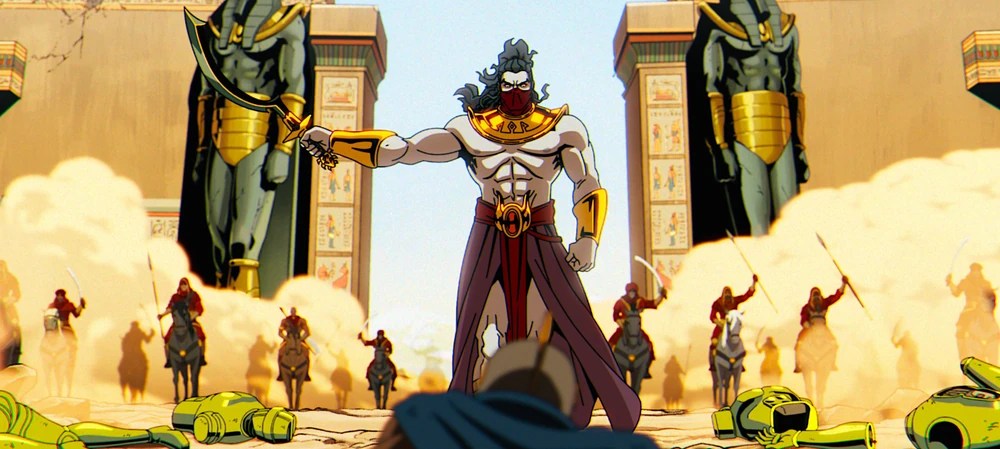
Rama‑Tut is alerted to the attack at his gates and sends his commander, Logos, to confront the intruders. As Nur and his followers storm forward, they are besieged by robot droids powered by the Pharaoh’s tech, which quickly tear through them. Logos is satisfied and orders the gate closed — but he has underestimated Nur’s strength. Nur single‑handedly breaches the city gates and defeats Logos. He lets him live to witness his rise to power.
Nightcrawler delivers robotic parts to Beast, who has constructed a makeshift time portal. However, he hasn’t the power to activate it, and isn’t even certain it will work. The Professor assures him to have hope.
Nur tortures Logos for information on the Pharaoh’s goal: a ship from the stars that will grant him ultimate power — Godhood. Preferring to learn as much as possible, Magneto asks Nur to spare Logos so Charles can read his mind. Baal, Apocalypse’s steadfast and loyal lieutenant, does not trust the X‑Men, but Nur grants them time.
Charles reaches into Logos’ mind but finds the secrets of the alien craft locked away. In a hellish landscape of Egyptian imagery, Charles is confronted by a loud voice that tells him he is unwelcome, and he is violently ejected from Logos’ mind. As the X‑Men rally to his side, Baal discovers banned tech in Beast’s possession. Assuming the X‑Men are traitors, Nur kills Logos, setting his destiny on a destructive path, and orders the X‑Men executed.
One of Nur’s followers reveals himself as Bishop, who wastes no time delivering each of his teammates a time device.
However, Logos’ death has activated a beacon, alerting Rama‑Tut to the location of his enemies. Using a massive burst of energy, he destroys Nur’s caverns, collapsing them in on Apocalypse and the X‑Men…
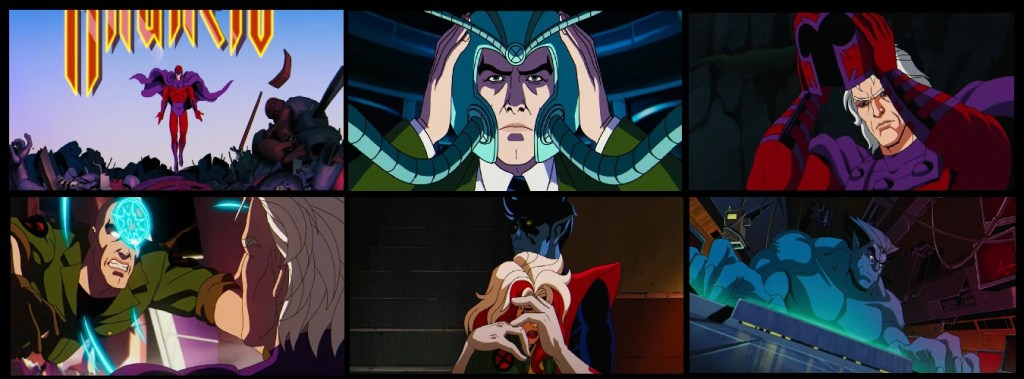
There are more new shots on the credits: Xavier using Cerebro; the Professor wiping Magneto’s mind from Tolerance is Extinction (Part 3); Nightcrawler and Rogue; and Beast, at the controls of a failing Ship from Obsession. Magneto’s uniform has also changed in his title card, from his X-Men one, back to his usual costume.
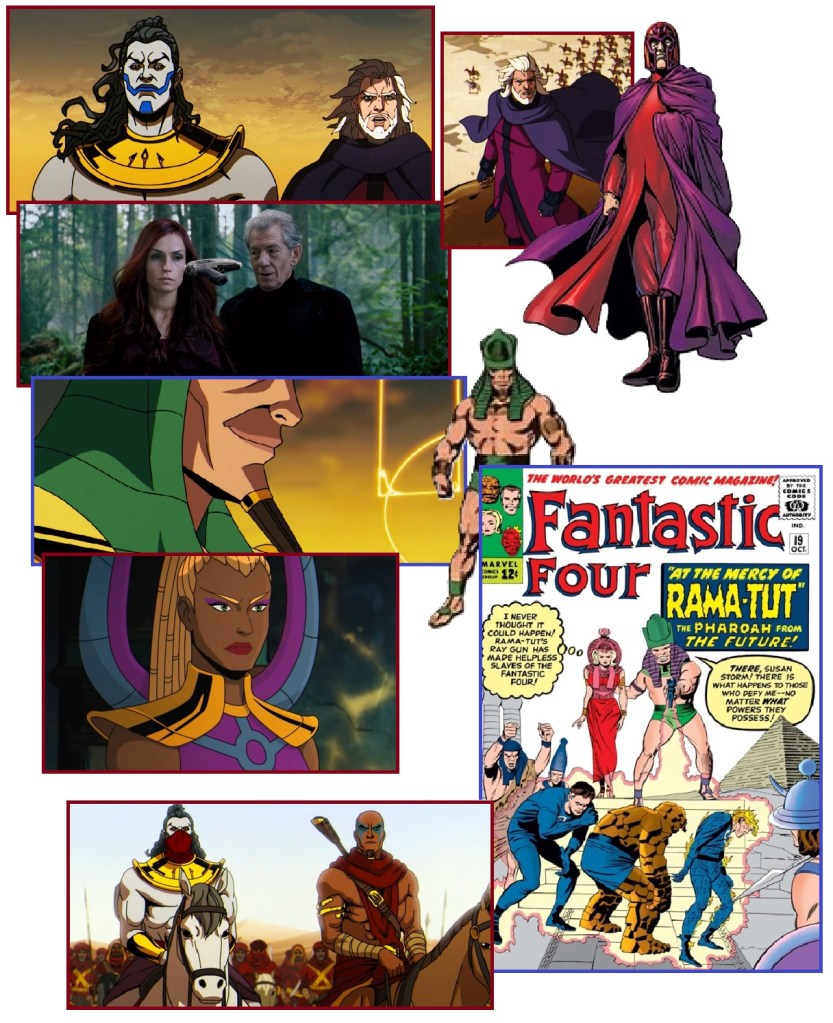
The scene at the episode’s opening is reminiscent of Magneto’s conversation with Dark Phoenix shortly before invading Alcatraz in X-Men: The Last Stand, even down to the position he’s standing in. His uniform in this era is similar to the one used by an imposter in New X-Men #150.
Rama-Tut is one version of Avengers villain Kang the Conqueror. We never see his face in this episode. Older than Kang, he decided to live his life in luxury as a Pharoah until he was defeated by the Fantastic Four in his first appearance in Fantastic Four (1963) #19. After that, he reportedly became Kang. Immortus, who also appeared in Beyond Good and Evil, is yet another version…
Surprisingly, one of Rama-Tuts attendants is the External Candra, last seen in X-Ternally Yours.
The story of Apocalypse’s past was largely told in the critically acclaimed mini series Rise of Apocalypse, which shares its title with this two-parter (see below).

Rogue’s uniform is based on her comic book uniform circa Uncanny X-Men #182.
Charles search through Logos’ mind featured imagery that implies both Apocalypse and Onslaught. The voice that speaks to him is Eson the Searcher, one of the Celestials, who appeared on the big screen in Marvel Studios’ Guardians of the Galaxy.
APOCALYPSE RISING
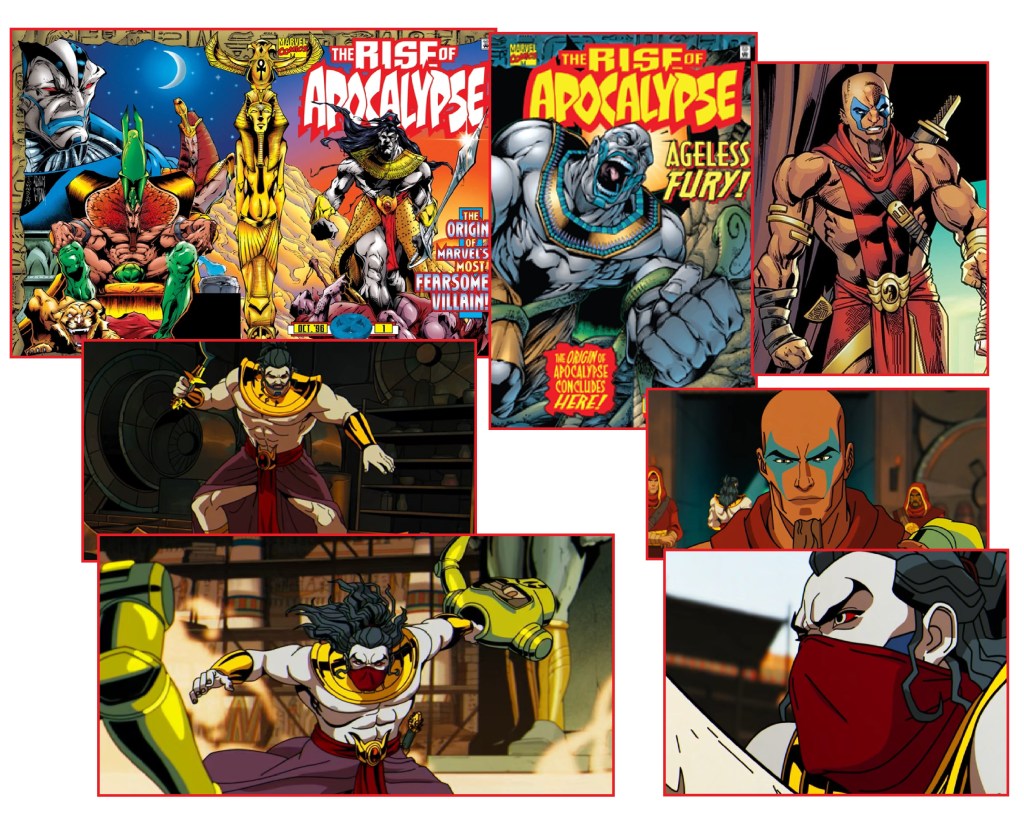
The Rise of Apocalypse mini‑series from 1996 is one of those origin stories Marvel told with a kind of quiet confidence, laying out the early life of En Sabah Nur without spectacle or interruption. It follows him from abandonment in the desert to his discovery by Baal and the Sandstormers, shaping him through hardship rather than destiny. The book treats ancient Egypt not as a backdrop but as a crucible, a place where cruelty, loyalty and survival define who Nur becomes long before the name Apocalypse carries any weight. Rama‑Tut’s arrival introduces the sci‑fi element, but even then the story remains grounded in Nur’s perspective — a boy confronting power he was never meant to see.
What stands out in the comic is how self‑contained it feels. There are no X‑Men, no time travellers (bar the obvious), no external forces nudging the timeline. Nur’s rise is presented as inevitable, shaped only by the world he was born into and the philosophy he adopts to survive it. Baal’s influence is paternal rather than strategic, and Rama‑Tut’s technology is a temptation rather than a battleground. The mini‑series is more interested in the psychology of Apocalypse than the scale of his future, showing how a single life can harden into a doctrine that will one day threaten the entire mutant race.
The animated version, by contrast, doesn’t retell that origin so much as intersect with it. This episode places the X‑Men inside the moment rather than outside it, letting them witness the rise instead of shaping it. Magneto’s encouragement, Charles’ warnings, Beast’s improvised tech — these additions don’t overwrite the comic’s beats, but they change the texture of the story. Apocalypse’s ascent is still inevitable, but now it happens with the team trapped inside the timeline, trying to survive the fallout. Logos’ death becomes the turning point, the moment Nur’s path locks into place, and the presence of the X‑Men adds urgency the comic never needed.
What the show gains is momentum. The collapse of Nur’s caverns, Bishop’s sudden arrival, Rama‑Tut’s retaliation — these are animated‑series flourishes that heighten the drama without breaking the lore. The comic gives Apocalypse a solitary rise, shaped by philosophy and cruelty. The show gives him a rise witnessed by the X‑Men, shaped by interference, desperation and the unstable timeline they’re trying to escape. Both versions tell the same story, but from different distances: the comic watches Apocalypse become a god, and the show lets the X‑Men see it happen.


Leave a comment